
On the campaign trail, I saw her standing in an open jeep, chatting with shopkeepers, energising crowds, and delivering confident speeches. I witnessed one such gathering at the red-painted Calcutta Port and Shore Mazdoor Union building near the harbour. She’s not your typical kurta-jhola communist; she’s a sharp, articulate, and confident young leader who truly stands out. She fought well and though lost, settled with increased vote percentage for the left.
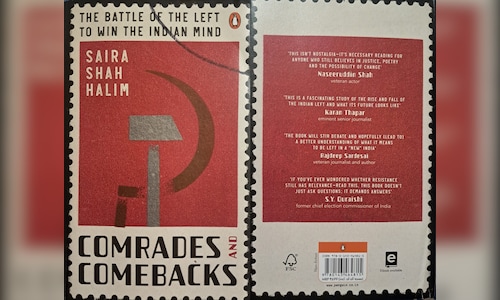
Saira Shah Halim’s debut non-fiction book is a bold attempt to take communism out of dusty old libraries and put it into the hands of the younger generation, using a voice and style they can relate to. This book fills a much-needed gap, something that tells the story of the Indian Left in a clear, engaging way, without sounding like a textbook. It couldn’t have come at a more relevant time, with the ongoing Russia-Ukraine war, Israel’s annexation of Gaza, and Gen Z-led protests overthrowing the long-standing communist regime in Nepal.
Saira’s ground-level work in politics gave this book an authenticity that no academic analysis could match. Spread across twelve thoughtfully structured chapters, this book takes readers on a sweeping journey through the world of communism. It begins with the origins of the movement and the lives of its revolutionary icons, offering a clear understanding of its core philosophies. The narrative then moves to India, highlighting communism’s pivotal role in the country’s freedom struggle, and maps its rise in states like West Bengal, Kerala, and Tripura in the post-Independence era.
Book’s language hooks you right away with a gripping style. From the very first page, “Che Guevara, the doctor, the revolutionary, the martyr, the lover. Be it his good looks or the fact that his life appears straight out of a Shakespearean tragedy, Che Guevara remains to me the quintessential Shakespearean hero,” the tone is set. Saira brings in quotes from thinkers like Engels and Chomsky to highlight the Left’s sharp intellectual roots and show it’s more than just slogans—it’s a serious, thoughtful movement. It plunges headfirst into the Left’s manifesto and drives home the power of human resilience in standing up to authoritarian, populist, and ruthless regimes around the globe.
Despite all its history and wisdom, the Left has definitely lost a lot of ground in India. Saira is honest about that and doesn’t hesitate to dig into why it’s happened. She points out how the rise of regional parties based on caste, language, and religion, along with the rapid spread of neoliberalism and financialisation in the 90s, really put the Left on the backfoot.
The book wraps up with a hopeful vibe, talking about reclaiming the narrative, reconnecting with grassroots supporters, and proving that the Left still has a place and a purpose in today’s world. Saira admits the stakes are high, but so are the opportunities. With some fresh thinking and new ideas, there’s still space for the Left to inspire a new generation to step up for justice, equality, and democracy. The show must go on.
—The author, Mehul Devkala, is a noted columnist and author. The views are personal.