

GUWAHATI: How deeply can an entire state and its diverse populations transform in a month? No, not from the outside. Not because of sparkling elevated roads that suddenly emerge to make travel lighter, global award-winning airports that attract international attention, or malls with facades so shiny that they throw back your reflection as if it were a giant mirror. From the inside.
.
There is no way to measure such abstract possibilities. But if you want to witness a phenomenon with little known precedent – just to challenge a theory perhaps, or a long-held belief regarding the nature of change and the time it takes – come to Guwahati and travel across Assam to see what’s happened in the 30 days since one of its most beloved icons, singer Zubeen Garg, died away from home in Singapore on Sept 19.
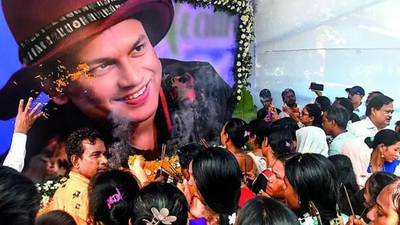
Earlier, not too long ago, when a visitor arrived in Assam, relatives, friends and tour guides would nudge the guest to first complete the two most important tasks in an unchanging Guwahati itinerary – darshan at the revered Kamakhya mandir and a stroll along the mighty Brahmaputra. Now, you’ll be asked to do one more thing – head to Sonapur, about 20 km away from the city, where Zubeen’s final resting place has metamorphosed into a shrine that welcomes thousands every day in an unending procession. A grand memorial will be up soon, the people have been promised. But grief can’t wait for monuments.
.
At the site of immense sorrow, an old man with a flowing beard and fraying kurta pock-marked with age, said, “Zubeen spoke for all of us.” Ashraful Syed, 73 years old, had come with his grandson Mobin, and granddaughter Hameeda. There were other Muslims milling around, listening intently to a women’s
naam-kirtan
group from Nagaon, who had brought along metal cymbals and traditional drums, singing sombre hymns under a shaky canopy where the elderly sat in plastic chairs and the young on bare ground.If lakhs of people from almost all corners of Assam filled highways, community halls and stadiums in mourning in the days following Zubeen’s death, and markets closed for weeks (old-timers said they hadn’t seen an outpouring of grief like this even when its other beloved star, Bhupen Hazarika, died in Nov 2011), it was also because of, like Ashraful Syed said, Zubeen’s courage and sense of inclusiveness.
.
He was secular in the most fundamental of ways, and brave – taking on the ULFA who stopped him from singing Hindi songs, the politicians who belittled the marginalized and persecuted, and the powerful who didn’t care much for their own people. And Zubeen did all this without a trace of self-importance, sitting on pavements with cash to give out to jobless youth, eating poori-sabji from paper plates on roadsides, making light of his drinking habit. Everything that a VIP wouldn’t. And he was loved universally for this.“Assam lost its darling child,” Sonalika Hazarika, 66, said at the Sonapur shrine. She’d come from Jorhat with three of her neighbours. “We come in small groups so as not to crowd the place. Others must also be given space. To pray for Zubeen’s peace and happiness. Assam’s too.”At what’s now called Zubeen Dham, there are long rows of cars parked on an uneven, oblong patch of land, a posse of new vehicles sliding in every minute to haggle for space. A newly erected toilet has begun to leak, unable to accommodate the thousands of fans and common folks who troop in every day. There are beggars and ice cream vendors. The kind you find near popular temples. A security contingent has been stationed to keep a watchful eye on the ever-expanding crowds. There are school kids in uniform, parents who’ve brought their children along, members of local music clubs, young men and women with partners. Even some policemen in khaki, who take off their shoes and leather belts to light a diya for Zubeen.Krishna Phukan, who says he repairs motorbikes at Ganeshguri in Guwahati, won’t celebrate Diwali. “Very few will,” he said, adding that he didn’t come for work until even a week ago. “But I ran out of money. Many traders are still reluctant to carry on their business. Ask anyone.”But Assam hasn’t just become sadder in the days following Zubeen’s passing. The heartbreak seems to have mutated into a larger discomfort and discontent. All sorts of answers and accountabilities are being sought, and the questions have gone beyond circumstances around the singer’s death.