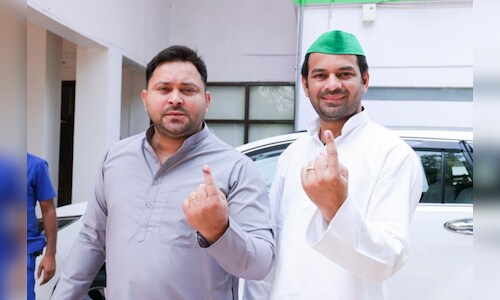

The Rashtriya Janata Dal (RJD) tops the list, with 30 of its 71 MLAs (42.25%) belonging to political families. Among these are prominent figures such as Tejashwi Yadav, Leader of the Opposition and son of Lalu Prasad Yadav and Rabri Devi, and his brother, former minister Tej Pratap Yadav. The RJD also has at least seven MLAs whose relatives have previously served as ministers, including Deepa Manjhi (daughter-in-law of former chief minister Jitan Ram Manjhi) and descendants of former chief ministers Jagannath Mishra and Harihar Singh.
The trend extends beyond the RJD. In the Janata Dal (United), 16 of its 44 MLAs (36.36%) are dynastic. The BJP’s count of dynastic legislators is only slightly lower than the combined total of RJD and JD(U), though the report does not specify the exact number. Among the Congress, four of its 19 MLAs (21.25%) hail from political families.
Seven ministers in the outgoing JD(U)-BJP government also come from dynastic backgrounds — including JD(U)’s Vijay Kumar Choudhary, Maheshwar Hazari, Sheela Kumari, and Sunil Kumar, as well as BJP’s Nitin Naveen.
The report further highlights the growing presence of second- and third-generation politicians. JD(U) minister Sumit Kumar Singh, whose father and grandfather both served as MLAs and ministers, represents the third generation of his family in politics. Other notable dynasts include Samrat Chaudhary, son of former chief minister Shakuni Chaudhary, and Santosh Suman Manjhi, son of former chief minister Jitan Ram Manjhi. RJD’s Yusuf Salahuddin, grandson of an MP, and JD(U) minister Ashok Chaudhary, son of a former minister, also feature among Bihar’s political heirs.
The findings highlight that the roots of dynastic politics are firmly intact in Bihar.