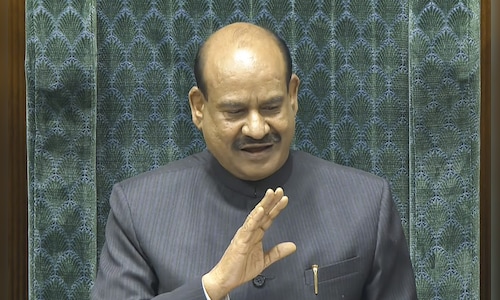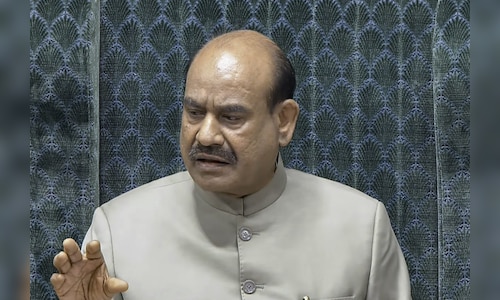

Lok Sabha Speaker Om Birla has directed the House Secretary-General to examine the no-confidence motion notice against him and further take appropriate action in the matter, ANI quoted sources as saying.
“At 1:14 pm today, we submitted a motion for a no-confidence motion against the Speaker under rule 94C rules and procedures,” Congress MP Gaurav Gogoi said.
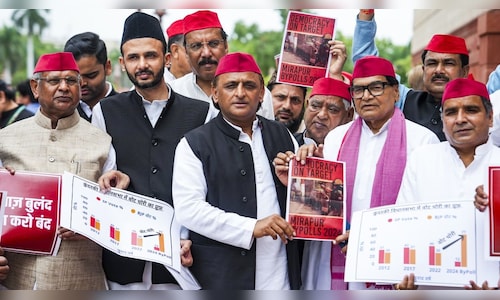
The notice to the Lok Sabha secretariat was submitted by Congress MP and chief whip K Suresh on behalf of Opposition parties, such as Congress, Samajwadi Party and the DMK. However, Mamata Banerjee-led TMC did not sign the notice.
As per reports, 118 MPs from different political parties have signed the notice for moving the resolution. Notably, the Lok Sabha has not functioned properly ever since the Leader of the Opposition was not allowed to speak on February 2.
In their notice, the Opposition leaders have accused Om Birla of behaving in a ‘blatantly partisan manner,’ adding that Rahul Gandhi is “almost invariably not allowed to speak”. They even mentioned the suspension of eight Opposition MPs.
They even highlighted Birla’s remarks post the adoption of Motion of Thanks to the President’s Address, where he stated that he had ‘credible information’ about Opposition MPs reaching the Prime Minister’s chair and carrying out ‘an unforeseen act.’
The notice from Opposition members said such allegations are “blatantly false and derogatory”.
What happens next?
Under the Constitution of India, the Speaker and Deputy Speaker of the Lok Sabha could be removed from office after a resolution is passed by a majority of the members of the Parliament’s Lower House. Article 94(C) of the Constitution deals with the procedure to move no-confidence motion against the Lok Sabha Speaker.
“A member holding office as Speaker or Deputy Speaker of the House of the People may be removed from his office by a resolution of the House of the People passed by a majority of all the then members of the House,” it states.
It adds, “Provided that no resolution for the purpose of clause (c) shall be moved unless at least 14 days’ notice has been given of the intention to move the resolution”.
As per rules, any member of the House can seek the removal of the Speaker. Under Chapter 18, the member is required to submit a written notice and the full text of the resolution to the Secretary-General of the House.
Later, a motion is entered in the List of Business, while the date to take up the motion is fixed. The motion is placed before the House, requiring at least 50 members to rise in support of it. Once the motion gets accepted, it is then put to a vote.
For now, it depends on the Deputy Speaker of Lok Sabha whether the motion will move forward. It is required to meet specific condition to be admissible.
In 2024, the Opposition moved a motion against then Vice President and Rajya Sabha Chairman Jagdeep Dhankhar. At the time, the Deputy Chairman dismissed the motion and termed it as an act of impropriety.
According to The Times of India, there were three occasions in the past when a no-confidence motion was moved to remove the Speaker. It started with the first Lok Sabha Speaker GV Mavalankar in 1954 by MP Vigneshwar Misra, followed by the opposition MP’s motion against Speaker Sardar Hukum Singh in 1966.
The third one was in April 1987 that sought to remove Speaker Balram Jakhar.