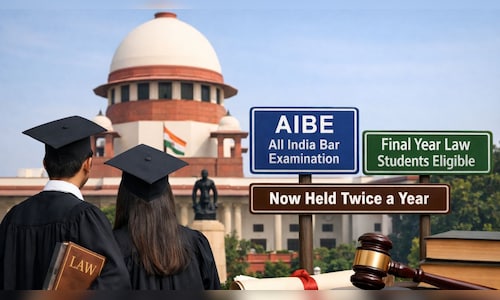

BCI also told the Court that the AIBE will now be conducted twice a year instead of once annually, as per Bar and Bench.
The submission was made on Tuesday, January 20, before a Bench comprising Justices Vikram Nath and Sandeep Mehta.
Twice-yearly examination cycle
According to the BCI, the revised framework ensures greater flexibility for law graduates entering the profession.
“This is the case where (it was sought that) last semester students should be allowed to sit for the AIBE. We have framed the rules. The prayers have been taken care of. The AIBE will be conducted at least twice a year and the last semester students will be allowed to sit for AIBE, subject to them clearing the final (semester) exam,” the counsel for the BCI was quoted as saying by Bar and Bench.
The Court recorded the submission and formally closed the proceedings.
“The counsel for the petitioner states that the purpose of the writ petition has been served. BCI has already framed AIBE rules 2026,” the bench said.
Background of the case
The petition had been filed by nine final-year law students from Delhi University, who challenged a BCI notification that barred students from taking the AIBE before completing graduation.
Clearing the AIBE is a statutory requirement to practise law in Indian courts.
During hearings in September 2024, the BCI had informed the Court that it was in the process of drafting rules on the matter. In the same month, the Supreme Court had directed the BCI to permit final-year students to register for AIBE XIX, scheduled for November 2024.
Students challenge BCI’s restrictions
The petitioners argued that the BCI’s restriction contradicted a Constitution Bench judgment which held that students eligible to pursue their final semester could be allowed to take the bar examination.
They also pointed out that in October 2023, Telangana High Court ruling that asked the BCI to revisit the issue in line with the Constitution Bench’s observations, as per Bar and Bench.
The students contended that the ban created an arbitrary distinction between candidates based on the timing of university result declarations, potentially delaying their professional careers.