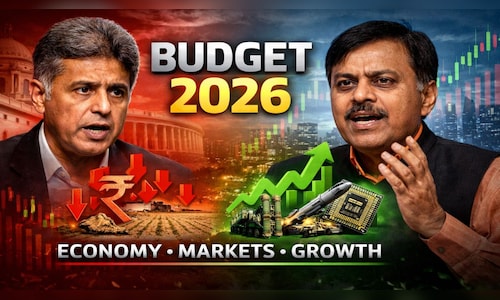

From the opposition benches, Manish Tewari, Lok Sabha MP, Congress argued that the Budget does not address deep structural weaknesses in the economy. He flagged weak nominal GDP growth, falling tax buoyancy and rising dependence on government borrowing.
“The nominal GDP in 2005 was 14%, in 2009 it grew by 20%, in 2026 it’s down to 8%. In fact, the difference between the real GDP and the nominal GDP is only about 1% which means that your tax buoyancy has completely and absolutely gone for a toss.”
According to him, private investment has not responded despite corporate tax cuts, production-linked incentives and lower GST rates. As a result, public capital expenditure continues to do the heavy lifting.
Tewari also raised concerns about agriculture and rural incomes, pointing out that growth in the farm sector has not reached the most vulnerable sections. He warned that high interest payments and rising debt leave limited fiscal space for future priorities. On new-age sectors, he questioned whether India’s spending on semiconductors and artificial intelligence is sufficient to compete globally, given the scale of investment by countries like China.
On national security, Tewari said defence challenges on multiple borders require far higher spending over time. He argued that India may eventually need to significantly increase defence expenditure as a share of GDP, even though current fiscal constraints limit flexibility.
Read Here | ‘This dwarfs every other proposal’: Raamdeo Agrawal on Budget’s data centre tax holiday
Defending the government’s approach, GVL Narasimha Rao said the criticism ignores how far the economy has come over the past decade. He highlighted that India is now among the world’s largest economies and remains the fastest-growing major nation, despite global uncertainty.
“The whole world is looking at India as a bright spot,” Rao said.
Rao stressed that higher borrowing is being used for investment, not consumption, with public capital expenditure at record levels and strong support for state-led infrastructure spending. He also underlined improvements in fiscal discipline, manageable debt levels and comfortable foreign exchange reserves.
On exports and manufacturing, Rao acknowledged global headwinds but said the Budget’s focus on reducing customs duties, building chemical corridors and supporting critical minerals reflects a long-term strategy. Welfare spending, he added, should not be seen as a burden but as essential for inclusive growth.
“This is a budget which is not to get brownie points in TV debates,” Rao said.
Read Here | Budget 2026 supports telecom, BSNL turnaround and digital push: Jyotiraditya Scindia
For markets, the debate captures a familiar tension. The government is projecting stability, infrastructure-led growth and policy continuity, which supports investor confidence. The opposition, however, is warning that weak private investment, pressure on consumption and limited spending on frontier technologies could constrain long-term returns.
How these competing narratives play out will matter for equities, especially in capital goods, defence, manufacturing, and technology-linked sectors, as investors weigh short-term stability against long-term structural reform.
For the entire discussion, watch the accompanying video