
The Lahore University of Management Sciences (LUMS) is also planning to include verses from the Mahabharata and the Bhagavad Gita. As part of the program, students are also exploring the Urdu rendition of ‘Hai Katha Sangram Ki’, the iconic theme from the popular Mahabharat television series.
Dr Ali Usman Qasmi, Director of the Gurmani Centre, told The Tribune that Pakistan has an important collection of Sanskrit manuscripts that has mostly been ignored by scholars since the country’s independence.
“Pakistan has one of the richest yet most neglected Sanskrit archives at the Punjab University library,” he said.
He also noted that although the number of students is still small, they hope it will grow in the coming years, and by spring 2027, they aim to offer Sanskrit as a year-long course.
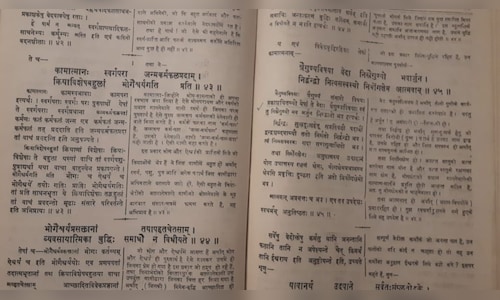
Dr Qasmi further said, “A significant collection of Sanskrit palm-leaf manuscripts was catalogued in the 1930s by scholar JCR Woolner, but no Pakistani academic has engaged with this collection since 1947. Only foreign researchers use it.”
He believes that by teaching Sanskrit at universities, Pakistan can develop local expertise to study and preserve these texts. “In 10–15 years, we could see Pakistan-based scholars of the Gita and the Mahabharata,” he added.
“People ask me why I’m learning Sanskrit. I tell them, why should we not learn it? It is the binding language of the entire region,” LUMS Associate Professor Dr Shahid Rasheed said.
He points out that Sanskrit is a shared cultural heritage of South Asia, not belonging to any single religion. He mentioned that the famous Sanskrit grammarian Panini’s village was in the region, and much writing was done here during the Indus Valley Civilisation.
“Classical languages contain much wisdom for mankind. I started with learning Arabic and Persian, and then studied Sanskrit,” he said, adding, “Modern languages derive from classical traditions. There is just a veil that separates them–once you cross it, you realise they are all our own.”
Since there were no teachers or textbooks, Dr Rasheed said he learned Sanskrit through online platforms, studying under Cambridge Sanskrit scholar Antonia Ruppel and Australian Indologist McComas Taylor. He said it took almost a year to learn classical Sanskrit grammar, and is still studying it.
“Sanskrit is like a mountain—a cultural monument. We need to own it. It is ours too, it’s not tied to any one particular religion,” he added.
Dr Qasmi notes that much of South Asia’s literature, poetry, art, and philosophy goes back to the Vedic age, and many historians believe the Vedas were written in this region.
“Imagine if more Hindus and Sikhs in India started learning Arabic, and more Muslims in Pakistan took up Sanskrit, it could be a fresh, hopeful start for South Asia, where languages become bridges instead of barriers,” said Dr Rasheed.