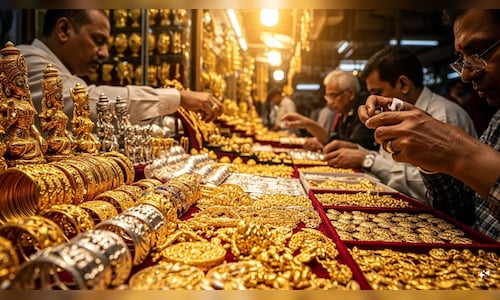

On the Multi Commodity Exchange (MCX), gold futures slipped 0.26% to ₹1.61 lakh per 10 grams of 24-carat purity, while silver declined 0.63% to ₹2.67 lakh per kilogram.
The subdued movement in domestic prices largely mirrored global trends, where bullion faced pressure from a firmer dollar and rising oil prices.
Global cues shaping bullion prices
Internationally, gold prices edged lower in early trade on Thursday (March 12) trade. Spot gold was down around 0.5% at about $5,151 per ounce, while US gold futures for April delivery fell 0.4% to roughly $5,156 per ounce.
A stronger US dollar — which gained about 0.3% — made dollar-denominated commodities such as gold more expensive for buyers holding other currencies, limiting fresh demand. At the same time, oil prices surged amid escalating tensions involving Iran and disruptions in the Strait of Hormuz, a key route for global energy shipments.
Iran has warned that oil prices could potentially surge toward $200 per barrel, while the International Energy Agency has called for a large release of strategic reserves to counter one of the biggest oil supply shocks since the 1970s. The jump in crude prices has raised concerns about renewed inflation pressures globally, which in turn has reduced expectations of near-term interest-rate cuts.
Why gold is consolidating
Market participants say bullion is currently caught between competing forces — geopolitical uncertainty that usually boosts gold demand and macroeconomic factors such as a stronger dollar and interest-rate expectations that tend to limit gains.
“Gold is holding steady compared with the previous session as investors remain cautious about their stance,” said Aksha Kamboj, Vice President of the India Bullion & Jewellers Association (IBJA) and Executive Chairperson of Aspect Global Ventures.
She noted that markets are balancing risk sentiment with policy expectations, leading to consolidation in prices around current levels.
Silver sees mild correction
Silver prices have seen a slightly sharper decline after recent gains. Analysts say the move reflects profit-booking following the metal’s strong rally in earlier sessions.
While the correction reflects near-term market adjustments, silver continues to attract attention due to its dual role as both an investment asset and an industrial metal, which often leads to higher volatility compared with gold.
Demand trends in the jewellery market
Industry participants also point to changing consumer trends in the jewellery market.
“Fluctuations in gold and silver prices are largely driven by shifts in consumer sentiment and broader global economic trends,” said Dishi Somani, founder of Dishis Designer Jewellery.
She added that gold continues to see strong demand as an investment asset even at elevated price levels, while silver is gaining traction among younger buyers due to its affordability and popularity in contemporary jewellery designs.
Longer-term demand remains strong
Despite short-term fluctuations, analysts say gold continues to attract strong investor interest globally and in India.
“Gold prices have seen significant fluctuations in recent weeks, but demand remains strong,” said Piyush Jhunjhunwala, Founder and CEO of Stockify. He noted that the precious metal has delivered around 10–12% returns over the past 12 months, outperforming several traditional investment options during periods of global uncertainty.
According to him, recent 2–5% corrections in prices are largely driven by movements in the US dollar and profit-booking after earlier rallies, which are typical in commodity cycles and may create fresh entry opportunities for long-term investors.
Jhunjhunwala added that central bank buying has also supported global gold demand, with institutions purchasing more than 1,000 tonnes of gold last year, reflecting continued confidence in the metal as a reserve asset.
For Indian investors, he said, gold remains an important portfolio diversifier.
“Concerns around inflation, currency volatility and global economic uncertainty continue to support demand for gold as both an investment asset and a store of value,” he added.
–With Reuters inputs