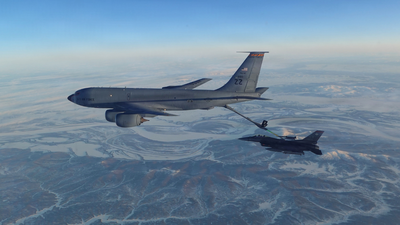


China’s military is moving to integrate artificial intelligence into one of the most complex aspects of air warfare — aerial refuelling — in what analysts see as both a technological leap and a strategic signal amid intensifying global military competition.The People’s Liberation Army (PLA) has unveiled an AI-assisted task dispatch system designed to optimise how its refuelling tankers support combat aircraft in real time. The announcement, carried by the PLA Daily, comes just days after a deadly crash involving a US Air Force Boeing KC-135 Stratotanker in Iraq, placing a renewed spotlight on the risks inherent in such operations.
Smarter skies, faster decisions
At the heart of China’s new approach is an “aerial refuelling area management system” that uses AI-driven algorithms to monitor airspace conditions and dynamically assign refuelling tasks. The system calculates fuel levels, flight durations and airspace capacity in real time, recommending optimal pairings between tanker aircraft and fighters.PLA officials say this replaces a far less efficient legacy model, where pilots often selected the nearest tanker, leading to congestion around some aircraft while others remained underutilised. By contrast, the AI system aims to distribute demand evenly, reduce delays and maximise mission endurance.The shift reflects a broader Chinese push to embed AI into operational decision-making, particularly in high-tempo combat scenarios where speed and precision can determine mission success.
A response shaped by modern warfare
The timing of the announcement is notable. The crash of the KC-135 tanker during Operation Epic Fury — which killed all six crew members — has raised fresh concerns about the vulnerabilities of ageing refuelling fleets and the dangers of mid-air operations in contested environments.While the Pentagon has ruled out hostile fire, questions remain over whether mechanical stress, human error or a mid-air collision contributed to the incident. The aircraft involved belongs to a fleet dating back to the Cold War era, still widely used despite decades of service.Chinese military commentators have pointed to such incidents to underscore the limitations of older systems. State media analysts argue that heavy operational tempo, especially in conflict zones, increases strain on both aircraft and personnel — risks that smarter automation could help mitigate.
Strategic implications
Aerial refuelling is a critical force multiplier, extending the range and endurance of fighter jets, bombers and surveillance aircraft. Improvements in this domain can significantly enhance a military’s ability to project power far from its borders.By introducing AI into this process, China is not just seeking efficiency gains but also attempting to reduce human workload and decision fatigue — factors that have historically contributed to accidents.However, the integration of AI into combat support systems also raises questions. Reliance on algorithms introduces new vulnerabilities, including potential system failures, cyber threats and the challenge of ensuring human oversight in high-stakes scenarios.
A widening capability gap?
The development may also signal a shift in how major powers approach aerial logistics. While the United States has begun modernising its tanker fleet with newer platforms, China’s focus on AI-enabled coordination suggests a different pathway — one that prioritises software-driven optimisation alongside hardware upgrades.As air forces prepare for increasingly complex and contested battlefields, the ability to efficiently manage airborne assets could prove as decisive as the aircraft themselves.In that context, China’s AI-assisted refuelling system is less about incremental improvement and more about redefining how aerial support operations are conducted — with implications that extend well beyond the immediate theatre of conflict.