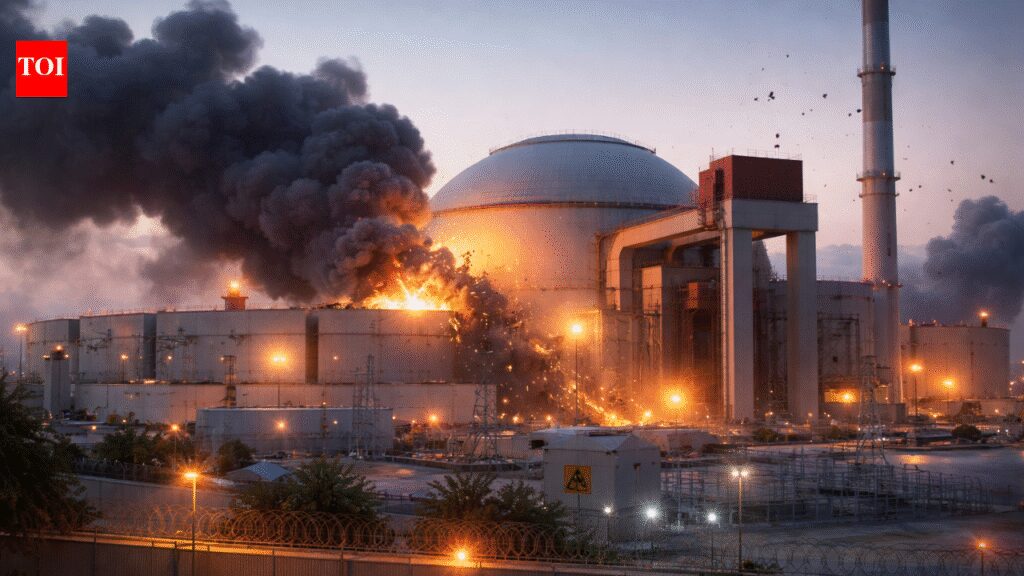


AI-generated image used for representation (Source: ChatGPT)
The International Atomic Energy Agency (IAEA) on Thursday said a “projectile hit” took place near Iran’s Bushehr Nuclear Power Plant, striking a structure about 350 metres from the reactor.In a statement posted on X, IAEA director general Rafael Mariano Grossi said the reactor itself was not damaged and no injuries were reported. However, he warned that any attack near nuclear facilities violates key safety principles. “Although there was no damage to the reactor itself nor injuries to staff, any attack at or near nuclear power plants violates the seven indispensable pillars related to ensuring nuclear safety and security during an armed conflict and should never take place,” he said.
The agency did not specify the nature of the projectile that struck the area near the Bushehr plant, located on Iran’s Persian Gulf coast, around 480 miles south of Tehran. The facility currently has one operational unit, with two additional Russian-designed units under construction.Iran and Russia have alleged that a projectile struck the premises of the Bushehr nuclear power plant, raising fears of a potential radiological incident amid Tehran’s ongoing conflict with Israel and the United States.While no leakage of nuclear material was reported after the Tuesday evening incident, it has once again highlighted longstanding concerns among Iran’s neighbours that the Persian Gulf facility could be vulnerable to attacks or natural disasters such as earthquakes.Alexei Likhachev, head of Russia’s state nuclear corporation Rosatom, earlier said the strike took place at 15:11 GMT on Tuesday and hit an area close to the plant’s meteorological service, near an operating power unit.
He stressed that safety remains the top priority, adding that personnel had already been partially reduced at the site. “The safety of human life is our absolute priority. We had previously partially reduced the number of personnel at the construction site of Bushehr Nuclear Power Plant Units 2 and 3. About 250 employees and their families were safely evacuated from Iran. Children of employees were preemptively evacuated before the armed conflict began. About 480 of our comrades remain there. Preparations for the third personnel evacuation are under way,” he said.Rosatom also condemned the incident, urging all sides to de-escalate tensions around the nuclear facility.The strike comes amid ongoing hostilities after the United States and Israel launched attacks on Iran on February 28, targeting its leadership and military infrastructure. Iran has since retaliated, and the conflict continues. Grossi has repeatedly called for diplomacy, saying that “to achieve the long-term assurance that Iran will not acquire nuclear weapons and for maintaining the continued effectiveness of the global non-proliferation regime, we must return to diplomacy and negotiations”.Also read: Israel bombs South Pars- Why does this gas field matter so much to Iran — and the world?The first unit of the Bushehr plant was connected to the grid in 2011. It is a Russian-designed VVER reactor with a capacity of 915 MWe. Two additional VVER-1000 units are under construction, with unit 2 progressing steadily since its first concrete was poured in 2019 and key structural components installed in recent years.Iran has indicated that unit 2 could become operational by 2029. According to Rosatom, work is also ongoing on unit 3. In September 2025, Rosatom and the Atomic Energy Organisation of Iran signed an agreement to cooperate on small modular reactors, as Iran aims to expand its nuclear capacity to 20 GW by 2041.
Bushehr spared in June conflict, scrutiny rises now
Bushehr, a functioning civilian nuclear power plant, remained untouched during the 12-day Israel-Iran conflict in June. During that period, the US targeted three Iranian nuclear enrichment sites, damaging centrifuges and likely burying Tehran’s stockpile of highly enriched 60% uranium underground. Since then, Iran has restricted access to those sites, blocking inspections by the IAEA.Any strike on an operational nuclear power plant raises the risk of radioactive leakage into the environment, a concern that has loomed large since Russia’s full-scale invasion of Ukraine in 2022, where nuclear facilities have repeatedly come under threat.A potential radiation leak into the Persian Gulf would pose an existential crisis for Gulf Arab nations, many of which depend heavily on desalination plants in the region for their water supply.