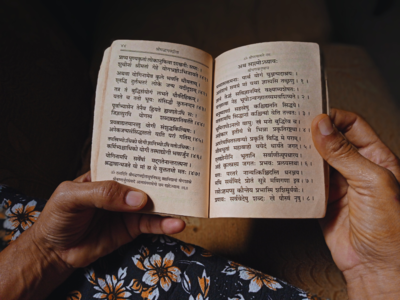


Sanskrit is one of the oldest and most influential languages in the world that holds a unique place in India’s cultural and history. Recognised as one of the 22 scheduled languages under the Indian Constitution, it enjoys official status at the national level. However, when it comes to state-level recognition, only a few states have taken concrete steps to formally adopt Sanskrit in administration. Uttarakhand was the first state in India to give the status of the second official language to Sanskrit in 2010. This was a landmark in the revival of the classical language in the modern world. Close to a decade later, Himachal Pradesh emulated this in 2019, and Sanskrit was given the same status. These steps were meant to popularize the learning and preservation of Sanskrit, which has both strong cultural and religious ties.
Canva
However, despite its ancient history, Sanskrit is still considered to have relevance in today’s world through its revival. Various government initiatives have been taken at both the national and state levels to promote and integrate Sanskrit into the education system. The language is commonly taught in schools as part of the curriculum. It is offered as a third language to students through various boards such as CBSE. The language is generally offered to students from Class 5 to 8. Sometimes, it is also offered as a second language to students in higher classes.Read more: Which country is called the “Land of Snakes”? Here’s the truth behind the name Beyond formal education, organisations like Samskrita Bharati have played a crucial role in popularising spoken Sanskrit. As of 2025, the organisation claims to have trained over 10 million people in conversational Sanskrit and prepared more than 135,000 teachers to use it as a medium of instruction. One of its notable initiatives is the establishment of over 6,000 “Sanskrit-speaking homes,” in which families use the language for day-to-day communication to revive it as a living and spoken language. According to the 2011 census, more than 3.1 million people in India identified Sanskrit as a first, second, or third language. However, only about 24,821 individuals identified it as their mother tongue. This difference points to the contrast between the popularity of the language from a learning perspective and the relative lack of it from a practical, everyday interaction perspective. Experts have also pointed out the possibility that the variation in the number of first-language speakers might be due to cultural affinity.Read more: World Happiness Report 2026: Finland tops again, Israel in top 10; India ranks 116th The revival of Sanskrit is not confined to India. There has been a surge of interest in the language across the globe, with institutions such as universities in Germany, the UK, the US, China, and others offering the subject. In a significant digital milestone, Sanskrit was added to Google Translate in 2022 after being one of the most requested languages, signalling its growing relevance in the digital age. The revival of the Sanskrit language has a history that goes back to the end of the 19th century, and the Theosophical Society was one of the first organisations that initiated the revival of the language. Today, this has grown into a full-fledged program, academic pursuit, and cultural movement in the name of keeping the legacy of this great language alive.Sanskrit is deeply rooted in its past and supported by its institutions and worldwide interest. Although it may not be commonly used as a living language, its continued existence in India’s educational and cultural arenas is part of a broader movement to keep this ancient language alive in this increasingly modern world.