
Today, regarded as Chief Minister Mamata Banerjee’s political fortress, Bhabanipur was not always synonymous with the TMC. For decades after Independence, the seat in south Kolkata was a Congress bastion and the home turf of some of the state’s most influential political figures.
Former chief minister Siddhartha Shankar Ray contested and won from the seat both as a Congress candidate and later as an Independent. Other Congress stalwarts such as Mira Dutta Gupta and Rathin Talukdar also represented the constituency, cementing Bhabanipur’s reputation as one of the party’s key urban strongholds.
For years, the constituency remained firmly within the Congress orbit, with the Left breaching it only briefly in 1969 when the seat was rechristened as Kalighat constituency. CPI(M) leader Sadhan Gupta, who became India’s first visually impaired parliamentarian in 1953, won the seat during the second United Front government of the Bangla Congress and the CPI(M).
Bhabanipur’s political journey took an unusual turn in 1972 when the constituency disappeared from the electoral map following delimitation. For nearly four decades, the seat existed only in political memory.
When it was revived in the 2011 delimitation exercise, West Bengal politics itself was undergoing a dramatic churn. That year marked the end of the Left Front’s 34-year rule and the beginning of the Mamata Banerjee era.
The newly reconstituted Bhabanipur constituency quickly became intertwined with the rise of the TMC. In the first election held there in 2011, Banerjee fielded her close aide Subrata Bakshi.
Bakshi won comfortably, securing over 64% of the votes and defeating CPI(M)’s Narayan Jain by nearly 50,000 votes, establishing Bhabanipur as a stronghold of the newly ascendant TMC.
Soon afterwards, Bakshi vacated the seat, allowing Banerjee — sworn in as chief minister after the TMC’s landslide victory — to enter the assembly through a by-election that effectively became her electoral coronation as an MLA.
Banerjee secured nearly 77% of the votes and defeated CPI(M)’s Nandini Mukherjee by over 54,000 votes, firmly anchoring her political base in Bhabanipur. Since then, the constituency has not slipped from the TMC’s grasp.
“Bhabanipur is not just another seat for us. It is where people have repeatedly reposed their faith in Mamata Banerjee’s politics of development and inclusiveness,” Kolkata Mayor and minister Firhad Hakim said.
Over the years, Bhabanipur has witnessed several high-profile contests involving heavyweight candidates from across parties, but the outcome has remained unchanged.
In the 2016 assembly elections, the Left and Congress forged an alliance and fielded senior Congress leader Deepa Dasmunsi against Banerjee in a contest framed as a “battle between Didi and Boudi”.
Despite the symbolism, Banerjee won comfortably with 65,520 votes against Dasmunsi’s 40,219. BJP candidate Chandra Kumar Bose, a member of the Netaji family, finished third with around 26,000 votes.
Five years later, in the 2021 assembly election, Banerjee shifted to Nandigram to challenge her former aide Suvendu Adhikari.
The TMC fielded senior leader Shovandeb Chattopadhyay in Bhabanipur, while the BJP nominated actor Rudranil Ghosh.
Ghosh secured 44,786 votes, the highest ever polled by an opposition candidate in the constituency, but still lost by more than 28,000 votes.
Bhabanipur’s political importance became even more pronounced later that year.
After her narrow defeat to Adhikari in Nandigram by 1,956 votes, Banerjee needed to win a bypoll to remain the CM. Once again, Bhabanipur stepped into the spotlight. Chattopadhyay vacated the seat and Banerjee contested the by-election against BJP’s Priyanka Tibrewal.
Banerjee returned to the assembly with a margin of more than 58,000 votes and nearly 72% vote share, reaffirming Bhabanipur’s status as her most reliable political base.
The Bhabanipur assembly segment, carved largely from wards of the Kolkata Municipal Corporation, reflects the social diversity of south Kolkata, with Bengali middle-class neighbourhoods alongside large Hindi-speaking trading communities. The constituency also houses the famed Kalighat temple, one of Kolkata’s most important religious landmarks, and Banerjee’s residence.
Rough estimates suggest Bengali Hindus constitute around 42% of the electorate, non-Bengali Hindus about 34% and Muslims roughly 24%.
Political analysts say this social mix has historically favoured Banerjee’s brand of urban populism.
“Bhabanipur reflects the cosmopolitan character of South Kolkata. Mamata Banerjee has built a personal political connect here that cuts across communities,” political analyst Biswanath Chakraborty said.
As the 2026 assembly elections approach, Bhabanipur is once again at the centre of West Bengal’s political narrative.
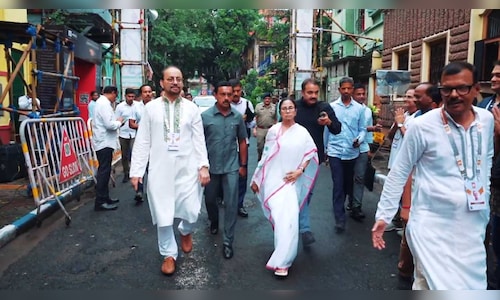
Banerjee is expected to contest from the constituency, while the BJP has fielded Leader of the Opposition Adhikari, who had defeated her in Nandigram in 2021.
The contest has added a dramatic new layer to the constituency’s political history.
“In Bhabanipur, the BJP is trying to convert the seat into a psychological battlefield,” Chakraborty said.
The SIR exercise has further intensified political debate around the constituency, with more than 47,000 names deleted from the voters’ list in Bhabanipur and over 14,000 electors remaining under adjudication pending verification.
“Times have changed in West Bengal. Seats once considered impregnable are now open to challenge, and Bhabanipur will be no exception,” BJP leader Sukanta Majumdar said.
Beyond the immediate contest, Bhabanipur, the seat that mirrors West Bengal’s shift from Congress dominance to Mamata Banerjee’s rise, now finds itself at the heart of the state’s most symbolic political battle.