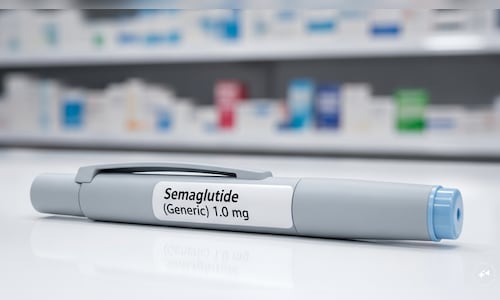

The initial wave of launches appears more limited than earlier expectations, even as pricing has seen a sharp reset.
Generic versions have been introduced at steep discounts, with monthly therapy costs ranging from about ₹1,290 to ₹8,000, compared to ₹8,800 to ₹16,400 for the innovator drug.
Among formats, vials have emerged as the most affordable option, with prices ranging roughly between ₹1,290 and ₹1,750 per month.
Glenmark has priced its weekly vial dose at ₹325. Pen devices, which offer greater convenience, are available at a premium, typically in the ₹1,800 to ₹8,000 range. Alkem, for instance, has introduced a once-a-week pen at ₹450 per week.
|
Monthly Cost for the Pen Device |
|
|
Natco Pharma |
₹4000-4500 |
|
Dr Reddys |
₹4200 |
|
Sun Pharma |
₹3000-8000 |
|
Eris Life |
₹4000-4500 |
|
Zydus Life |
₹2200 |
|
Alkem |
₹1800 |
|
USV |
₹4300 |
Prices under which cos have launched the vial (not the pen)
|
Monthly Cost per Month for Vial |
|
|
Natco Pharma |
₹1290-1750 |
|
Eris Life |
₹1290 |
|
Glenmark |
₹1300-1760 |
Zydus Lifesciences has introduced multiple brands, while Sun Pharma has entered both the diabetes and weight-loss segments. Torrent Pharma has differentiated itself with the launch of an oral version alongside injectables.
A clear segmentation is emerging within the market. Players such as Alkem, Natco, Eris and Glenmark are positioning themselves as low-cost disruptors, while Zydus occupies the mid-tier segment.
Larger companies like Sun Pharma and Dr Reddy’s are targeting the premium generics space.
Analysts expectation
Analysts expect the market to be largely volume-driven, with the top three to four players likely to gain share. Companies are also attempting to differentiate through offerings such as patient support and self-care programmes.
Dr Reddy’s, for example, has introduced SEMAKARE in partnership with Nestle. The company expects the domestic market opportunity to expand to about $1 billion, with room for further price cuts as competition intensifies.
Some firms estimate that individual brands could scale beyond ₹50 crore if competitive intensity remains moderate.
Market size could grow
Brokerages say that the sharp price reduction following genericisation could improve affordability and expand the addressable market.
Estimates suggest the market size could grow nearly sixfold from around ₹1,400 crore currently to about ₹8,300 crore, with long-term potential of reaching ₹28,500 crore.
CLSA believes that while all early entrants stand to benefit, companies such as Sun Pharma and Torrent Pharma may capture a relatively larger share.
Macquarie mentioned that the entry of generic GLP-1 drugs has been accompanied by aggressive pricing and incremental innovation, though a full range of semaglutide formats is yet to be rolled out.
It sees Torrent, Sun Pharma, Lupin and Eris as well placed to gain from incremental demand, noting Torrent’s first-mover advantage in the oral segment and differentiated device strategies among larger players, particularly Zydus.
Goldman Sachs also pointed out that multiple Indian drugmakers launched generics immediately after the loss of exclusivity on March 21.
It said that while vial pricing reflects deep discounts of nearly 90%, pen devices, which are expected to see wider adoption, are priced at relatively lower discounts.
The brokerage expects a sharp volume uptick following genericisation and estimates the India GLP-1 market could reach $1.5 billion by FY31.