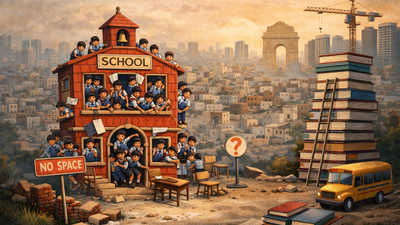


For years, the policy push in school education has been bringing more children into the system. On that count, Delhi has performed. Enrolment has held, even expanded. But as PTI’s report based on UDISE+ 2024–25 data suggests, the physical capacity of schools has not kept pace with this expansion.According to the UDISE+ data cited by PTI over 44.9 lakh students are enrolled across 5,556 schools in the capital, which translates to roughly 800 students per school. The number is not alarming enough to trigger panic. It is, however, high enough to raise an uncomfortable question about how much capacity Delhi’s schools are expected to absorb before “access” starts looking like congestion. Crowding in schools shows up in stretched classrooms, timetable compromises and corridors before it is visible in policy documents.
The ratio looks fine, the strain remains
On another metric, the system appears stable. Delhi has 1.61 lakh teachers, keeping the overall pupil-teacher ratio (PTR) at about 28:1, broadly within prescribed norms, PTI reports. But the aggregate figure becomes less reassuring once the internal distribution is examined more closely.Teacher deployment is heavily weighted towards the higher classes. According to PTI, 26,560 teachers are posted at the foundational and preparatory stages, 11,564 at the middle level, and 1,23,834 at the secondary level. The PTR, too, varies across stages: 14:1 at the foundational level, 18:1 at the preparatory level, 28:1 at the middle level, and 19:1 at the secondary level.This is where averages begin to mislead. A compliant ratio does not automatically translate into a comfortable classroom. It tells us little about how many sections a school is running, how large or cramped its classrooms are, or how far infrastructure is being stretched to absorb rising enrolment. A school may satisfy PTR norms on paper and still function at the edge of its physical capacity. Ratios, after all, do not reveal whether a school actually has enough usable space for the number of students packed into it.There are other signals in the data that complicate the picture further. PTI reports that more than 1,000 students are enrolled in single-teacher schools, a reminder that resource distribution remains uneven even within an urban system.Infrastructure, too, is layered. While most schools have basic facilities, more advanced infrastructure remains limited. Digital libraries, for instance, are available only in a small fraction of schools, according to the PTI report.None of this points to neglect so much as to a system that has expanded faster in enrollment than in physical design.
Delhi schools grow, but land constraints remain a hurdle
The government has, predictably, turned to expansion. PTI reports that Delhi plans to build around 50 new school buildings and add nearly 8,000 classrooms by 2026–27. The response is both expected and necessary. A system under visible pressure cannot stand still.But the announcement also opens up a more difficult question. Can school infrastructure in a city like Delhi expand fast enough to match the density it is expected to serve? Land in Delhi is limited and expensive, with competing urban priorities making it harder to set aside space for new schools.And the next round of expansion may not resemble the old model at all. It may require taller school buildings rather than larger campuses, smarter use of existing premises, and a more deliberate integration of shared facilities. In other words, the challenge is no longer just to add schools. It is to rethink how school space itself is imagined in a crowded city.
When access stops being the only question
Delhi may no longer be dealing with a classic access problem. What is emerging instead is a capacity question hiding inside an enrollment success story. UDISE+-based data makes that tension hard to ignore. The real test now is whether school expansion in the capital can move beyond numbers and respond to the physical realities of teaching, learning and growing in a crowded city.