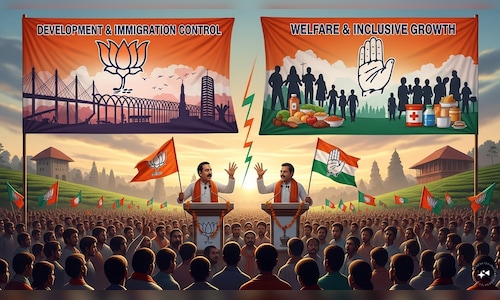

The documents arrived days apart. Different tone. Different priorities. But some overlap on welfare and land.
BJP manifesto: identity, land rights, and enforcement focus
The BJP’s 31-point ‘Sankalp Patra,’ released in Guwahati by Nirmala Sitharaman, leans heavily on continuity. The party links its promises to what it calls a decade of change in the State.
Key planks include moving toward a Uniform Civil Code, with exemptions for Sixth Schedule areas and tribal groups, and a sharper push on immigration enforcement. The manifesto backs use of the Immigrants (Expulsion from Assam) Act, 1950, removal of encroachment, and land rights for ‘genuine citizens.’
ALSO READ | Assam elections: Parties sell old promises with renewed vigour to tea tribes
Chief Minister Himanta Biswa Sarma underlined protections for land and cultural identity. The document also proposes new laws to tackle what it terms ‘love jihad’ and ‘land jihad.’
On welfare and economy, the party promises free education from KG to PG for weaker sections, expansion of teaching staff, and a phased increase in Orunodoi assistance to ₹3,000 with wider coverage. It commits ₹5 lakh crore in investments to position Assam as an ‘Eastern Gateway,’ with a focus on connectivity.
The manifesto also mentions time-bound implementation of peace accords and a dedicated mission under the Chief Minister.
ALSO READ | Assembly Elections 2026: No exit polls from 7 am of April 9 till 6:30 pm of April 29, says EC
Congress manifesto: Welfare push and institutional reforms
The Congress’ ‘Raijor Istahar,’ unveiled by Rahul Gandhi and the state leaders, including Gaurav Gogoi, outlines 28 commitments. The pitch centres on institutional reform and targeted welfare.
Among headline promises: Scheduled Tribe status for six communities, an Anti-Corruption Commission to probe alleged scams, and a white paper on state finances. The party also proposes an Urban Flood Mitigation Plan.
Five ‘guarantees’ include ₹50,000 support for women to start small businesses and land rights for 10 lakh indigenous people. The plan sets timelines -100 days for initial measures, one year for institutional changes, and five years for broader transformation.
Other commitments span universal healthcare, full school enrolment, police reforms, fast-track courts, and decentralised governance with public reporting. Sector-specific steps include welfare boards for gig workers and transport operators, revival of the tea industry with improved wages, and climate-focused planning.
ALSO READ | Assembly Elections 2026: How to check full candidate list, affidavits and other details
Additional proposals touch culture and professions: a Zubeen Garg Fellowship, a Centre for Art and Culture, an Advocates’ Welfare Fund, and subsidised land for accredited journalists.
Key overlaps and sharp differences ahead of April 9 vote
Both sides promise land rights and expanded welfare. The divide is sharper on identity laws, enforcement, and the role of new institutions. Voters now weigh delivery records against proposed timelines as the campaign enters its final stretch.