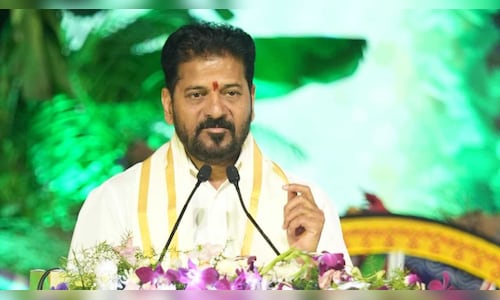

Telangana Chief Minister Revanth Reddy has stepped up his opposition to the proposed Lok Sabha seat expansion and delimitation exercise, writing to Prime Minister Narendra Modi and Tamil Nadu Chief Minister M. K. Stalin, calling for a united stand among southern states.
In his letter to the Prime Minister, Revanth Reddy raised concerns over the proposal to increase Lok Sabha seats to 850, cautioning that adopting a pro-rata (population-based) model could disturb the federal balance. He clarified that women’s reservation, delimitation, and seat expansion are distinct issues and urged the Centre to implement 33% reservation for women immediately with the existing 543 seats.
“While delimitation can be carried out by redrawing constituency boundaries, the proposal to increase Lok Sabha seats to 850 has become contentious. Adopting a pro-rata model for seat allocation could lead to a serious imbalance in the federal structure,” he said.
The Chief Minister pointed out that southern states, including Telangana, have effectively implemented population control and achieved better human development outcomes, but now risk losing political representation under the proposed system.
In a separate letter to Stalin, Revanth Reddy called for a coordinated effort among southern states to resist what he termed a “disguised” attempt to reintroduce a population-based model through the pro-rata formula. He recalled the delimitation conclave held in Chennai in 2025 and stressed the need for unity in opposing such measures.
He explained that while all states may see an increase in absolute seats, the relative gap in representation would widen significantly. For instance, he noted that the gap between Tamil Nadu and Uttar Pradesh could increase further under the proposed model, reducing the relative political influence of southern states.
“This effectively means the voice and influence of southern states in Parliament will diminish in relative terms, even as their contribution to the nation continues to grow. Progress will be penalised while population growth will be rewarded,” Reddy warned.
Revanth Reddy also flagged financial disparities, stating that southern states already face inequities in resource allocation despite contributing significantly to the national economy. He cautioned that the proposed changes would add “political injustice” to existing economic imbalances.
As an alternative, he proposed a “hybrid model.” “Half of the additional seats could be allocated based on population, and the remaining half based on economic contribution and development indicators such as GSDP. This will ensure no state is penalised for progress while maintaining fair representation,” he suggested.
He urged the Centre to convene an all-party meeting and called for a united effort among southern and like-minded states to take up the issue at the national level.
Meanwhile, Union Minister G. Kishan Reddy dismissed the Chief Minister’s concerns, accusing him of politicising the issue.
“In 2010, the Congress could not pass the Women’s Reservation Bill and used it for political gain. Even now, they are trying to benefit from it. We are clear in our approach and will move forward,” he said.
Responding to the delimitation argument, Kishan Reddy questioned the logic behind linking seat allocation to economic contribution.
“If delimitation is done in Telangana on that basis, will you agree to allocate 70% seats to Hyderabad since it contributes 70% of the state’s revenue? Will you reduce seats in Adilabad?” he asked.
The exchange has intensified the political debate over delimitation, with southern states increasingly voicing concerns over representation and federal balance.
Revanth Reddy also wrote another letter to Karnataka CM Siddaramaiah, raising concerns about the proposed pro-rata increase in Lok Sabha seats, arguing it would widen the political representation gap between northern and southern states. He highlighted that a population-based allocation would disadvantage southern states despite their significant contributions to economic growth and population control, and suggested a hybrid model balancing population with economic performance.
“Under a pro-rata model, the relative voice of southern states will diminish even as their contributions to the nation continue to grow. This approach risks creating a structural imbalance in political representation, widening the gap between states. If implemented, it will lead to a systemic shift in power that disadvantages states committed to development and population stabilisation. We must collectively oppose any move that results in such political injustice and work towards a fair, balanced alternative,” the Telangana CM said.