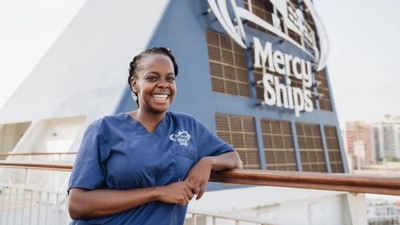


Left in a bag by the roadside in Kenya as a newborn, Becky Chaplin’s life began in extreme vulnerability. Years later, she is helping rebuild lives in some of the world’s poorest countries, using her skills to treat patients who are often rejected by their own communities.Becky was discovered by chance, still with her umbilical cord attached, by a vet out jogging. She was taken to an orphanage and later adopted by British parents. At the age of 10, she moved to the UK, eventually settling in East Grinstead. Growing up, she said she “always had a heart to come back to an African country”, a feeling that would later shape her career.Now an occupational therapist, Becky chose to volunteer with Mercy Ships, a faith-based international development organisation that operates hospital ships in countries with limited access to healthcare. Her work took her to Sierra Leone, where she played a key role in improving rehabilitation services.One of her major contributions was helping train the first group of physiotherapists on board the organisation’s hospital ship. Sierra Leone only established its first university-level physiotherapy course in 2018. By 2023, Becky was mentoring its first 15 graduates. Before this, the country had just six fully trained physiotherapists for a population of around nine million people.She described the programme as “a fantastic move forward in access to training”, noting that earlier, students had to travel abroad to places such as Ghana, Cuba or Kenya to qualify.Alongside training, Becky also worked to develop local services, drawing on her experience in the burns unit at the Queen Victoria Hospital in East Grinstead. Her focus has been on helping both children and adults living with disabilities.Speaking to BBC Radio Sussex, she explained how patients with burns or visible injuries are often treated. “Because of disfigurement, burns patients were often shunned or abandoned by communities,” she said.Through surgery and rehabilitation, she has seen patients regain not just physical ability but confidence. “We see them transforming, their personalities come out and then they go home with joy and with a testament of change,” she said.She also acknowledged that not every case ends with full recovery. In those moments, the focus shifts. “In those situations, what we do is share love, Jesus’ love and also we get them to a place where they can engage back in their community,” she said.From being abandoned at birth to becoming part of life-changing care for others, Becky Chaplin’s journey has come full circle, rooted in both personal history and a clear sense of purpose.