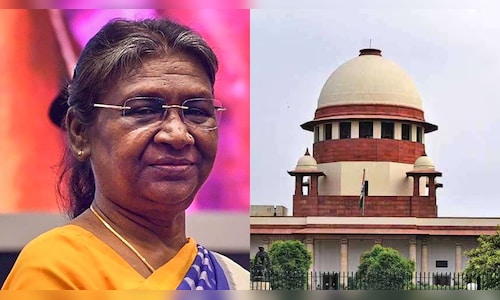

The act of penning letter to the apex court is in line with Article 143(1) of the Indian Constitution, which states: “If at any time it appears to the President that a question of law or fact has arisen, or is likely to arise, which is of such a nature and of such public importance that it is expedient to obtain the opinion of the Supreme Court upon it, he may refer the question to that Court for consideration”.
In the president’s letter, three questions stood out in the context of a series of recent stand-offs between the Tamil Nadu government and Tamil Nadu Governor over constitutional rights of a democratically elected government versus the powers held by the office of state governors with respect to ratifying legislation.
The three questions from President Murmu’s letter are as follows:
Question No. 3: Is the exercise of constitutional discretion by the Governor under Article 200 of the Constitution of India justiciable?
Question No. 4: Is Article 361 of the Constitution of India an absolute bar to the judicial review in relation to the actions of a Governor under Article 200 of the Constitution of India?
Question No. 5: In the absence of a constitutionally prescribed time limit, and the manner of exercise of powers by the Governor, can timelines be imposed and the manner of exercise be prescribed through judicial orders for the exercise of all powers under Article 200 of the Constitution of India by the Governor?
Read more: President Murmu seeks Supreme Court’s opinion on timelines for assent to Bills, poses 14 questions
Clash between TN government and Governor
The Tamil Nadu government and state’s governor R N Ravi have engaged in a long-standing war of words over the governor’s constitutionally-vested rights and whether or not the office of governors have the powers to overturn legislation passed by democratically elected state governments.
Later, the TN government took the Governor to court for delaying the passage of 10 bills passed by the state legislature, but were pending presidential assent.
In April, a constitutional bench of the Supreme Court directed Governor Ravi to pass 10 bills pending his assent within a timeframe of three months. The DMK-led government in Tamil Nadu celebrated the ruling, calling it a victory for democracy. However, the president’s questions to the Supreme Court quoting constitutional provisions may have cut short those celebrations.
That is primarily because President Murmu has questioned the constitutionality of the timeline that the court imposed on Governor Ravi – in his case three months to provide assent to 10 pending bills. “In the absence of a constitutionally prescribed time limit, and the manner of exercise of powers by the Governor, can timelines be imposed?” the president’s letter asks.
Read more: Supreme Court sets three-month deadline for President to decide on Bills referred by Governor
CM Stalin questions BJP over President’s reference
Tamil Nadu Chief Minister M K Stalin hit back at the questions. “Is the BJP seeking to legitimise its Governors’ obstruction by allowing indefinite delays in Bill assent? Does the Union government intend to paralyse non-BJP State Legislatures?” he asked.
What would also give Tamil Nadu’s legal eagles some head-scratching is President Murmu’s suggestion that actions taken by governors or the office of the president may not be subject to judicial review, as per Article 361 of the Indian Constitution, which states: “The President, or the Governor or Rajpramukh of a State, shall not be answerable to any court for the exercise and performance of the powers and duties of his office or for any act done or purporting to be done by him in the exercise and performance of those powers and duties.”
While a basic interpretation of this constitutional provision would negate the April ruling against Governor Ravi, President Murmu, in her letter, goes so far as to ask the question that is on everyone’s mind: “Is Article 361 of the Constitution of India an absolute bar to the judicial review in relation to the actions of a Governor under Article 200 of the Constitution of India?”
In response, Stalin said that the entire presidential reference exercise in the first place was an attempt to “subvert” the apex court’s settlement of the governor’s constitutional position. “I strongly condemn the Union Government’s Presidential reference, which attempts to subvert the Constitutional position already settled by the Hon’ble Supreme Court in the Tamil Nadu Governor’s case and other precedents,” the chief minister’s statement said.
The CM added that President Murmu’s letter gives away the BJP-led Centre’s “sinister intent to distort” Constitutional provisions and render Opposition-led state legislatures useless. “I urge all non-BJP states and party leaders to join this legal struggle to defend the constitution,” he concluded.
Indications are rife that the latest face-off between the Tamil Nadu Government and its governor, which has now seen the president step in, could signal the start of a whole new chapter in the acrimony that has existed between legislature and Governor RN Ravi.
Read more: Supreme Court calls for performance audit of judges over breaks