The Delhi Assembly election crystallised the party’s woes, as its refusal to ally with the Aam Aadmi Party (AAP) split the anti-Bharatiya Janata Party (BJP) vote, handing the BJP a decisive 48 seats to AAP’s 22, while Congress languished with none. This blunder, compounded by losses in Maharashtra, Haryana, and Gujarat’s municipal polls—where its vote share shrank to single digits—lays bare a party adrift, its storied legacy as India’s independence torchbearer fading into memory.
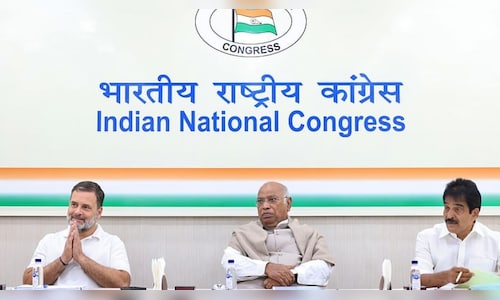
Once a colossus commanding national imagination, Congress now grapples with a shrinking base and a fractured INDIA bloc, its erstwhile allies like TMC and SP voicing frustration at its overbearing ways. The Ahmedabad meet looms as a potential pivot, a chance to arrest this slide before Bihar’s 2025 election and Uttar Pradesh’s 2027 contest test its mettle further. Yet, doubts swirl — Can Rahul Gandhi’s leadership, earnest but unproven at scale, steer it from the abyss? Will the party forge a compelling vision beyond symbolic yatras, or mend its coalition chaos?
The stakes are stark — with BJP’s machinery humming and regional players like AAP seizing urban ground, Ahmedabad isn’t just a meeting—it’s a referendum on Congress’s survival. Decisions there could spark renewal or cement irrelevance as a nation watches a giant teeter.
A Legacy in Tatters
Congress, once the indomitable architect of India’s independence, now grapples with a legacy in tatters as it nears the AICC meet. The 2024 Lok Sabha election briefly sparked hope with 99 seats—a modest rise from 2019’s 52—hinting at a national foothold against the Bharatiya Janata Party (BJP).
Yet, state polls swiftly extinguished this optimism, exposing a party unable to convert goodwill into wins. In Haryana’s October 2024 election, Congress clinched just 37 of 90 seats despite a 39.09% vote share, hobbled by internal rifts and a rejected AAP alliance, letting BJP’s 48 seats prevail. Maharashtra’s November 2024 rout was starker—16 of 101 contested seats within the Maha Vikas Aghadi, a 12.42% vote share dwarfed by BJP’s 132-seat dominance, with losses like Prithviraj Chavan’s signaling decay. While, Gujarat’s 2025 municipal polls saw its vote share sink to single digits—a far cry from past glory.
This unraveling stems from a shrinking base, organisational rot, and strategic blunders. Analysts argue rebuilding demands a reckoning—reviving grassroots, shedding outdated tactics—but time dwindles before Ahmedabad. The AICC meet looms as a crucible: Can Congress confront its erosion against a relentless BJP and skeptical voters? Without bold reform, its historical resonance risks fading into irrelevance, a once-towering force reduced to a fragile echo.
Leadership Vacuum
Rahul Gandhi’s stewardship of the Indian National Congress, though reinvigorated after the 2024 Lok Sabha polls, has yet to deliver the decisive thrust needed for a party revival. His July 2024 Gujarat visit rallied workers, but the party’s municipal tally there crashed from 12 in 2020 to a solitary win in 2025—a stark testament to faltering leadership. Critics decry the high command’s centralised grip, epitomised by the Gandhi family’s dominance, as a chokehold on grassroots dynamism. Despite Mallikarjun Kharge’s presidency, decision-making orbits Rahul Gandhi, sidelining broader talent.
The Bharat Jodo Yatra and Bharat Jodo Nyay Yatra fueled momentum pre-2024, lifting Congress to 99 Lok Sabha seats, yet post-election missteps—evident in Haryana’s 37-seat flop (October 2024), Maharashtra’s 16-seat rout (November 2024), and Delhi’s 2025 spoiler role—reveal a lack of cohesive direction. Analysts point to strategic blunders, like spurned alliances and over-reliance on Jat votes in Haryana, as symptoms of this vacuum.
Ahmedabad AICC meet could pivot toward decentralisation, empowering district units, but without a unifying figurehead, Congress risks floundering against the BJP’s disciplined machinery. Rahul’s rebuilding rhetoric has rung hollow before—loyalists like Hardik Patel defected in Gujarat as sycophants filled key posts, eclipsing genuine talent. The meet must break this cycle, or Congress’s leadership void will deepen its slide into irrelevance.
Alliance Muddle
The Indian National Congress faces a coalition conundrum as the INDIA bloc teeters on the brink of collapse, a fracture glaringly exposed during the 2025 Delhi Assembly election. Regional heavyweights like the Trinamool Congress (TMC) and Samajwadi Party (SP) have lambasted Congress for its perceived arrogance, accusing it of dictating terms rather than negotiating. This inability to broker deals has ceded ground to nimbler regional players, eroding Congress’s national stature. Political observers note that TMC’s solo stance in West Bengal and SP’s frustration in Uttar Pradesh highlight a bloc plagued by mistrust.
The Ahmedabad meet offers a critical juncture to mend these rifts, especially with Bihar’s 2025 election and Uttar Pradesh’s 2027 vote looming. Yet, Congress’s agility remains unproven. Before Delhi election, some party leaders claimed the INDIA bloc was a 2024 Lok Sabha construct, while Rahul Gandhi’s speeches tout its ongoing relevance—sowing confusion.
Ideological Reset
The Party is in an ideological limbo—neither fully committed to secularism nor adept at populism—leaving it exposed in a dynamic political arena. The Bharatiya Janata Party (BJP) dominates with a compelling mix of development and cultural identity, while the Aam Aadmi Party (AAP) captures urban voters with its focus on governance. Congress hopes its “Save Constitution” yatra, slated to kick off at the Ahmedabad AICC meet, will cast it as a protector of democratic principles—a foil to BJP’s assertive nationalism and AAP’s practical appeal. Yet, analysts caution that without depth beyond rhetoric, this gambit may ring hollow. Rebuilding demands a sharp, unified vision, a daunting task with mere weeks to shape it.
Rahul Gandhi has championed this constitutional narrative in recent elections—Haryana in October 2024, Maharashtra in November 2024, and Delhi in 2025—yet it has consistently failed to stir voters. Observers note that while it resonates with a narrow progressive circle, it falls flat among the wider public preoccupied with livelihoods, prices, and local issues.
So, Ahmedabad meet demands clarity— Congress must articulate a cohesive strategy, shedding its muddled stance, or risk further alienating allies and fading into irrelevance against a unified BJP.