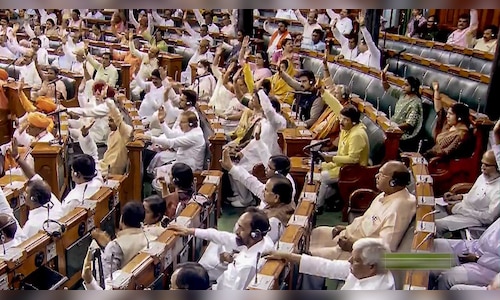

Far from a routine legislative exercise, the opening day revealed a nation wrestling with its identity, priorities, and power dynamics, setting the stage for a contentious month ahead.
Chaos characterised the first day, with heated exchanges fueled by the National Education Policy (NEP), the Waqf Bill, and language issues. During the NEP debate, Union Education Minister Dharmendra Pradhan engaged in a heated debate with DMK MPs about the three-language formula, a policy that Tamil Nadu has long opposed as an infringement on its linguistic identity. Pradhan accused the DMK of “dishonesty” and jeopardising students’ futures, branding their stance “undemocratic” and rooted in political opportunism.
DMK lawmakers fired back, defending their rejection of the policy and decrying Pradhan’s remarks as an insult to Tamil Nadu’s people, escalating tensions to the point of adjournments. Meanwhile, the Waqf Bill, aimed at reforming Islamic endowment management, drew sharp opposition protests, with critics alleging it infringes on religious autonomy, while the government touted it as a transparency measure. Manipur’s ongoing violence added further fuel, as MPs clashed over the state’s governance crisis under President’s Rule.
From delimitation fears in southern states to tariff threats posed by global trade shifts, this session encapsulates India’s multifaceted challenges. The explosive start underscores a Parliament at a crossroads, where every issue —from education to economics — carries the potential to spark a broader conflagration, testing the nation’s political resilience.
Manipur’s Crisis and President’s Rule: A Governance Flashpoint
Manipur’s ongoing ethnic violence, claiming over 250 lives since 2023, has thrust the state into chaos, culminating in President’s Rule on February 13, 2025, after Chief Minister N. Biren Singh’s resignation. Today, Home Minister Amit Shah will seek parliamentary approval for this federal takeover, while Finance Minister Nirmala Sitharaman tables Manipur’s budget. The opposition, particularly Congress, is poised to hammer the government for its failure to restore peace, turning this into a referendum on the BJP’s northeastern strategy and coalition stability.
The Waqf Bill Sparks Debate and Dissent on Day One
On the first day, the Waqf (Amendment) Bill, 2024, ignited heated discussions and protests, underscoring its contentious place in India’s legislative landscape. The bill, aimed at reforming the management of Waqf properties, was a focal point as the government sought its passage, while the opposition mounted a fierce challenge, reflecting deep-seated political and social divides.
The day began with stormy scenes in both the Lok Sabha and Rajya Sabha. As proceedings commenced, opposition MPs, including those from the Congress, DMK, and CPI, disrupted the session with slogans against the bill, accusing the government of undermining Muslim rights and constitutional values. CPI MP P. Sandosh Kumar articulated this sentiment, declaring, “The Waqf Bill is a serious issue, and we will try our best to stop it.” Reports showed that the opposition was determined to stop what they saw as an intrusion into religious matters.
Yesterday’s events signal a protracted battle ahead. The Waqf Bill, which will remain a crucial test for India’s legislative balance between reform and religious autonomy until April 4, is expected to spark further debate and dissent in the coming days.
Delimitation Debate: North vs. South Tensions
The proposed delimitation of parliamentary constituencies has ignited a fierce North-South divide, with southern states like Tamil Nadu fearing a loss of representation if based on updated population data. The DMK, rallying regional allies, has fiercely opposed what it perceives as a northern bias favoring states with higher population growth.
Chief Minister M.K. Stalin has spearheaded calls to retain the 1971 Census framework, arguing that southern states, penalised for effective population control, risk diminished political clout. This clash — pitting federal equity against regional influence — threatens to fracture national unity and has emerged as a defining issue, poised to dominate parliamentary rhetoric throughout the session.
Southern MPs, led by the DMK, disrupted proceedings with protests, demanding assurances against seat reductions. The government faced accusations of favoring northern states, where population surges could translate to more seats, amplifying their legislative sway.
US Tariffs Threat: Economic and Diplomatic Stakes
Donald Trump’s reciprocal tariff warnings have jolted India, with Congress demanding clarity on trade talks after claims of tariff cuts. As global economic pressures mount, the government must defend its strategy—balancing farmer and industry interests against US relations—while the opposition exploits any perceived weakness. With Foreign Secretary Vikram Misri briefing Parliament tomorrow, this issue could redefine India’s international standing and domestic economic narrative.
Voter List Clash Set to Dominate
Another issue that promises a fierce showdown between the government and the opposition over alleged voter list manipulation. On the opening day, the INDIA bloc, led by Leader of Opposition Rahul Gandhi, thrust the issue into the spotlight, demanding a detailed parliamentary debate. Gandhi highlighted widespread concerns about discrepancies in electoral rolls, asserting that the integrity of democracy hinges on addressing these anomalies. The INDIA bloc ally TMC, which has vocally criticized duplicate voter IDs and electoral irregularities, echoed his call, amplifying the opposition’s unified stance.
The government, however, appears poised to deflect these charges, with ruling party leaders dismissing them as baseless attempts to undermine the electoral process. Published analyses suggest this clash could derail legislative agendas, as the opposition leverages the issue to question institutional credibility ahead of future polls. The session, running until April 4, risks becoming a battleground over transparency versus trust in governance. With Rahul Gandhi spearheading the charge and TMC reinforcing the narrative, the voter list controversy is set to dominate discourse, testing the resilience of both parliamentary decorum and India’s democratic framework.
This session is no routine affair. From Manipur’s turmoil to the Waqf Bill’s fallout, and delimitation’s regional divide to US tariff brinkmanship, it’s a high-stakes showdown. The consequences will reverberate throughout India’s political landscape, challenging both the government’s resilience and the opposition’s strength well into 2025.
— The author, Prof. Sayantan Ghosh (@sayantan_gh), is a political observer and columnist who teaches journalism at St. Xavier’s College, Kolkata. The views expressed are personal.
Read his previous articles here