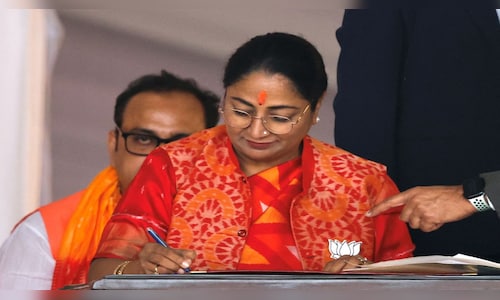

Having come to power accusing the previous AAP government of misgovernance and indulging in corrupt practices, the BJP under Chief Minister Rekha Gupta lost little time in tabling a couple of the Comptroller and Auditor General findings on them in the Assembly. The first was on the now-scrapped liquor policy of the Arvind Kejriwal government and the other was on AAP’s flagship public health programme.
Overall, the CAG had sent 14 performance audit reports to the Delhi Lieutenant Governor during the previous regime. The government did not table these reports in the assembly, a requirement under the Constitution. These are now being undertaken by the present regime. Ahead of the Delhi polls, when the issue reached the Delhi High Court, it directed these be tabled during the first session of the new Assembly.
As per the convention, Speaker Vijendra Gupta referred the portion of the tabled report on Delhi’s health infrastructure to the Public Accounts Committee, whose report will determine its future course.
The AAP, which occupied the opposition benches in the Assembly, chose to act in a disruptive manner. The newly-elected legislators of AAP decided to create a ruckus and stall the proceedings of the House only to be sent out from the House by the Speaker. This was poor tactics and strategy by the party now being led in the assembly by former Chief Minister Atishi.
Instead of embarking on tactics to disrupt the proceedings the party which has over 20 legislators should have utilised the opportunity to record its view by taking part in the debate. By indulging in activities that led to expulsion from the House, the legislators would have been far more effective in countering the charges being levelled against its government and defending the action which is now being questioned. In the absence of the opposition, only what the BJP members said form part of the authentic legislative record. There will be no contrary view available for researchers or historians unless accessed in contemporary publications elsewhere.
Of course, outside the assembly, AAP has taken its role as the party in opposition with the seriousness it deserves. The party has been seeking to raise political temperature over the BJP’s announcement to provide ₹2,500 per month allowance for women setting a deadline of March 8, observed as the International Day of the Women. The AAP wants to hammer in the point that the BJP is not serious about implementing its promise to the women of Delhi.
Besides making the promise in the run-up to the elections, the BJP has listed the work the government would do in the customary address by the Lieutenant Governor to the assembly. On Wednesday, Chief Minister Rekha Gupta declared the BJP would not be pressured to roll out the plan for women. This can be interpreted that the nascent government is feeling the pressure being mounted by the opposition. Yet, reports suggest the BJP is planning to announce the modalities to enrol the beneficiaries on Saturday.
The real test for the BJP will be during the Budget session beginning in the last week of March. The Budget proposals would make it clear as to how many of the promises the party made in its manifesto are on the way to becoming policies and how these would be rolled out. The session will provide the AAP an opportunity to take on the government. The Budget proposals would have to be debated in the Assembly and the House will have to vote on it.
It is during this first Budget session, AAP can highlight the deficiencies by going through the fine print of the proposal. Despite the absence of party stalwarts in the House, the AAP can draw upon its reservoir of experienced colleagues with administrative experience and a dedicated team of researchers to analyse and decode the Budget proposals for the welfare of the people.
—The author, K V Prasad, is an author and political analyst. The views expressed are personal.
Read his previous articles here
(Edited by : Unnikrishnan)
First Published: Mar 7, 2025 1:46 PM IST