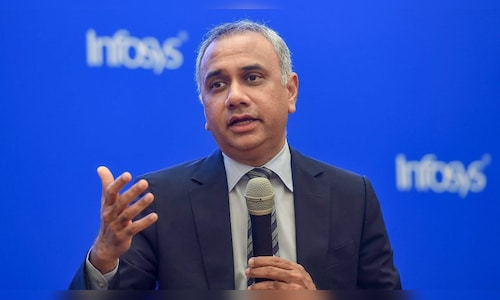

While Tata Consultancy Services (TCS) has announced plans to cut over 12,000 jobs this fiscal, Parekh told CNBC-TV18 that Infosys is not considering workforce rationalisation and is instead going ahead with its hiring plans.
“We had a strong recruitment in the first quarter, over 17,000 employees, both lateral and from colleges, and our plan for the full year is to recruit 20,000 college graduates. And that continues,” Parekh said.
Infosys’ position stands in sharp contrast to TCS, which confirmed to CNBC-TV18 that it will reduce about 2% of its workforce in FY26. CEO K Krithivasan had attributed the decision to a growing skills gap and the lack of redeployment feasibility for mid and senior-level roles amid changing technological demands.
Industry body Nasscom echoed those concerns, warning of further “workforce rationalisation” in the near term. In a statement, it noted that Indian IT is “pivoting toward product-aligned delivery models” and that traditional skillsets are being re-evaluated.
NASSCOM, of which TCS is a member, stated that the rise of AI and automation is reshaping delivery frameworks and urged the industry, academia, and government to bridge the emerging skill divide.
Parekh, however, suggested that Infosys is better positioned to weather these changes.
“Our utilisation is running at a good level, and with that, we see that all of the people that are joining us [are] getting deployed on projects,” he said.
“We see two components to AI: One is growth, such as in data and cloud, which support AI itself; and second, where we see productivity benefits, which gives us more efficiency in doing the work we were doing in the past.”
Asked whether Infosys was insulated from the kind of rationalisation others are warning about, Parekh reiterated, “The reskilling that we’ve started with AI, earlier with digital, is what is helping us, and making sure that our people are getting deployed at a high utilisation level.”
He also addressed the broader anxiety surrounding potential job losses due to AI. While NASSCOM and several industry leaders have spoken of an “existential” challenge to the traditional IT services model, Parekh declined to characterise the situation in such stark terms.
“Technology is becoming more and more critical for clients. AI is more critical. Infosys has invested and built out AI capabilities and other supporting capabilities — data, cloud — and that becomes important for clients. And for us, we remain well positioned to support our clients,” he said.
While Infosys’ headcount has come down over the past two years, Parekh noted that the company’s current employee strength, at 3.23 lakh, is actually 8,000 more than the same time last year, and said that will be sufficient to meet the company’s 1-3% revenue growth guidance for FY26.
“We have also improved what we do in terms of revenue efficiency per employee. So those two elements together will continue here, with the growth that we’re looking at for this year,” he said.
Internally, Infosys is investing in small language models, productivity tools like GitHub Copilot, and has re-skilled over 2.75 lakh employees in varying levels of AI.
“We’ve taken a view to make everything inside Infosys AI-first,” Parekh said. “We built four different small language models — one horizontal, one on IT operations… [and] we’re working with most of the major foundation models in supporting our clients.”
Even as the sector navigates a post-pandemic slowdown and changing client expectations, Infosys appears committed to long-term investments in talent and technology.
“What we understand from the market today is there is overall expansion in the addressable market, and that gives us a good traction,” Parekh said.
Also Read: The bar is rising for techies