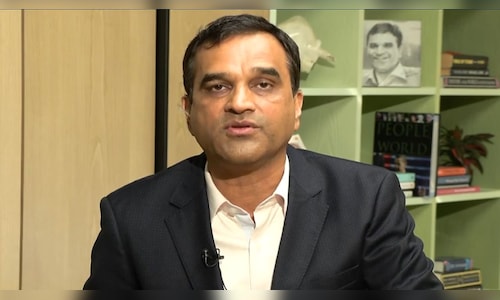

Speaking exclusively to CNBC-TV18, he said the situation is temporary and could in fact present opportunities for long-term investors.
“India and the US share a long strategic relationship. It’s only a matter of time before this gets resolved. My base case is certainly not that it will drag on for a very long time,” Kela said. He pointed out that some sectors had already frontloaded exports to deal with uncertainty. For instance, gems, jewellery, textiles and footwear exporters had advanced shipments, ensuring that the current season was not lost.
Kela argued that even if tariffs extend for a few months, the broader market may not be significantly hit. “In a $13 billion gems and jewellery export basket, only 5% is value addition. It is not even represented meaningfully in the Nifty. And footwear exports to the US are just $2 billion. With the current excise duty cuts and domestic demand, India can easily absorb that volume,” he said.
According to him, Indian markets are supported by strong domestic flows, which now account for 85% of ownership. “Foreigners today own only 15% of our market, the lowest I have seen in many years. Whenever there is a blip, domestic investors step in. Indian investors are becoming very intelligent,” he added.
On investment strategy, Kela said he prefers to keep a list of quality companies ready and use such corrections as buying opportunities. He cited the example of pharma stocks, which may fall in the broader market correction but are unlikely to be targeted by US tariffs. “I don’t believe the US will put tariffs on generic pharma. Their population is dependent on cheap drugs from India. If certain pharma companies fall 25–30% without a change in fundamentals, those are opportunities to buy,” he said.
Kela also welcomed the government’s GST rate cut, calling it a decisive step. He expects more measures to follow. “If you go by history, whenever there is a challenge, the Modi government has acted decisively. The GST cut may just be the beginning. The government seems on the front foot and will do everything needed to boost domestic consumption and growth,” he noted.
Asked about whether FMCG and consumption stocks could see a revival, Kela was cautious but optimistic. “It may be too simplistic to just buy the entire sector. This has to be a bottom-up call. But there are companies that will benefit both from GST rationalisation and their own strategies. Liquor, for instance, has been one such pocket. The idea is to identify such opportunities to generate differentiated alpha,” he explained.
In conclusion, Kela maintained that while short-term uncertainty remains, India’s domestic strength, investor maturity and government policy action give him confidence. “Unless this drags on for over a year, I don’t see it derailing earnings or the market framework. For investors, these are the times to prepare a list and be ready to act,” he said.
Below is the excerpt of the interview.
Q: It’s been a tough time. When the 50% tariff was announced, I thought the 25% tariff wouldn’t actually happen, but it did. Now we have to deal with it, hopefully not for too long. What do you think will happen next? Also, the market is actually higher than before the 50% tariff was announced. So, has this tariff really had much impact? Will the effects show up slowly over time, or is the market already factoring it in? What are your thoughts?
Kela: I would say, first of all, India and the US have a very long strategic relationship and a long history of how this relationship has played out. If you look at the latest statements, even from the US government side, it doesn’t look like there is any standoff, clearly. My point is that it’s only a matter of time before this tariff situation gets resolved. I am, at least, not making it a base case that it will not get resolved and will carry on for a long period of time. That is surely not the base case.
The other thing is, let’s say if it gets resolved in one, two, or three months, a lot of people—because this noise has been going on—I was talking to a diamond trader friend of mine, and he was saying that whatever we needed to export to the US, because we were living in uncertainty, 80% to 90% of that has already been done in the last few months. This season, actually, is not, in a way, lost. Whether we do the deal now or in 15 days, I don’t think it will have a huge impact on these businesses that people are saying will suffer a lot.
Thirdly, I think whatever we are reading—and as much as you and I both have the same sources—I think the government seems to be in a mood to take this as an opportunity to decisively address the issue of the economy. I think the GST cut was a decisive step that was needed. And I think many more measures should come to ensure that we are able to really boost the Indian economy and Indian consumption, and stand on our own feet. Whatever indications we have got directly from the Prime Minister, starting with the August 15 announcement till date, are all pointing towards the resolve to really put the economy back on track. And whatever setback could have happened because of this issue is more than compensated by our growth on the domestic side.
I would not be very perturbed. Obviously, if you tell me that this is not going to get resolved and will take one year to get resolved, then we will have to assess things in a different manner.
Q: It doesn’t change your investing framework or the kind of things you would get exposure to? Maybe there will be leaders and laggards, and some things will get delayed, but that’s about it. That’s the way to treat this, right?
Kela: In 35 years of my investing career, whenever we have had this kind of blip in the market and we know that the event is not going to last forever, I think this is when we get opportunities to really buy companies we like. So typically, for a person like me, I keep my list ready, and I keep some prices in mind. If those stocks—whether they belong to this category or are collateral damage because of the market mood—that is where you get opportunities to really invest money.
Q: But let me play devil’s advocate just for a second here. You said if it prolongs to, say, a year and there’s still no trade deal, then you’ll have to reassess. But let’s say this impasse continues for three to six months, because the rhetoric from the US side is very strong right now—if it persists for three to six months, will you have to reassess expectations of an earnings revival? Because that is really what investors and the market have been waiting for so long.
Kela: There are lots of ifs and buts. It is your opinion versus my opinion, or XYZ’s opinion. I’m just saying, right now we all only have opinions, right? My personal sense, as I was saying, is that because this has been going on for a long period of time, wherever we could actually prepone our exports to America, we have already done more than 50% of what we normally do in the first four or five months of the current year.
What I’m trying to say is that many sectors like gems and jewellery, textiles, or footwear may have seen exports getting preponed because of this uncertainty, both from a buyer’s as well as a seller’s perspective.
The other thing is that the market is assuming this is a 50% duty. It’s not as simple as that. A major portion of our exports are exempt—maybe around 50%. On the other 50%, if you analyse—for example, on $13 billion of gems and jewellery, you have only 5% value addition. It is not representing gems and jewellery in that sense. It’s not represented anywhere in the Nifty or broader market. Our total footwear exports to America are $2 billion. Now, don’t you think that with this excise duty cut and the current mood of “Make in India,” we can consume an additional $2 billion of footwear in this country of 145 crore people?
Watch the video for more