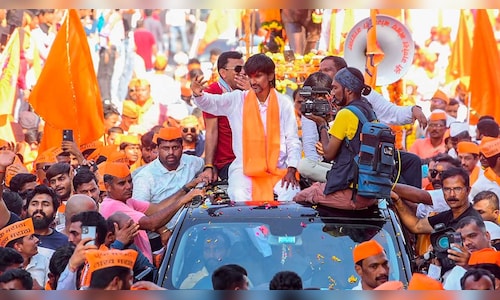

This is not the first time Mumbai has witnessed such scenes.
In 2016, after the rape and murder of a minor girl from the community, Maratha protestors had paralysed South Mumbai. In 2017, they returned with demands for reservation, once again bringing the city to a standstill.
In January 2024, too, Jarange Patil had led thousands to Navi Mumbai, planning to protest at Shivaji Park. But then CM Eknath Shinde intervened, and the march dispersed at Vashi.
The rise of Manoj Jarange Patil
Jarange Patil emerged as the tallest face of the Maratha reservation movement in August 2023, when he launched a hunger strike in Jalna’s Antarvali Sarathi village demanding full reservation. Violence broke out after a police lathi-charge in September, forcing multiple rounds of talks with the state government.
The government assured it would verify Kunbi Maratha records documented during the Nizam era. Jarange Patil demanded that the 54 lakh Kunbi Marathas identified, along with their relatives, be granted OBC status. While Kunbi Marathas had already been given OBC status in 2004, Jarange insisted on extending it widely. He had warned that if certificates were not issued by January 20, he would march towards Mumbai.
The state said the exercise was massive and could not be completed by the deadline. On January 20, Jarange began his march from Jalna with lakhs of supporters, intending to stage a protest at Azad Maidan on Republic Day. Then CM Shinde again met him, and the march was withdrawn.
Now, months later, Jarange Patil has brought his supporters right into Mumbai once again.
The legal and political context of the Maratha reservation
In February 2024, the Maharashtra Assembly unanimously passed a bill granting 10% reservation for Marathas in jobs and education in a special session. The Legislative Council too cleared it.
The bill cited findings that the Maratha community makes up 28% of the state’s population, with 21.22% of BPL Maratha families holding yellow ration cards (higher than the state average of 17.4%).
A survey conducted in early 2024 found that 84% of Maratha families do not fall under the “progressed” category, making them eligible for reservation under the Indra Sawhney judgment. The bill also noted that 94% of farmer suicides in Maharashtra are from Maratha families.
With this, Maharashtra’s total reservation quota touched 62%, breaching the 50% cap. The bill was challenged in the court. The Bombay High Court allowed the Maratha quota on an interim basis, but the matter is pending before the Supreme Court.
This comes against the backdrop of the Supreme Court’s 2021 judgment striking down earlier Maratha quotas, holding that there were no “extraordinary circumstances” to justify exceeding the 50% ceiling. Review and curative petitions filed by the state were also rejected.
Historical background of the movement
-
1953: PM Nehru formed the Kaka Kalelkar Commission, India’s first Backward Class Commission. It concluded Marathas were not eligible for reservation.
-
1961: The BD Deshmukh Committee marked Kunbis as backward but excluded Marathas.
-
1980s: The Mandal Commission classified Marathas as a forward caste.
-
1982: Congress leader Annasaheb MK Patil, who demanded Maratha reservation, committed suicide when his reservation demands were not met. It was a turning point in the movement.
-
1995: The Khatri Commission again did not recognise Marathas as backward.
-
2008: The RM Bapat Commission rejected Maratha claims, but the report was shelved by the state government ahead of elections.
-
2014: The Narayan Rane Committee recommended reservation, the government announced a 16% quota in jobs and education months before elections. The Bombay HC later stayed it.
-
2018: The Gaikwad Commission categorised Marathas as socially and educationally backward. Based on this commission’s report Maharashtra Govt led by Devendra Fadnavis, passed a Maratha reservation bill granting Marathas 16% in jobs and education. The HC reduced it to 13% in jobs and 12% in education.
-
2021: The Supreme Court struck down the quota entirely, reinforcing the 50% ceiling.
-
2023: Manoj Jarange Patil started his hunger strike and lathi charge happened at Antarwali Sarathi village.
-
2023: Maharashtra government started surveying documents of Kunbi Marathas’ relatives under the ‘Sage Soyare’ project to allot caste certificates to them so that those people can be eligible for a reservation under the OBC category, a step critised by the OBC community.
-
2024: A bill granting 10% reservation to Marathas in jobs and education was passed which was later challenged in the court
Maratha leaders and politics
Despite several Maratha Chief Ministers, Sharad Pawar, Vilasrao Deshmukh, Vasantdada Patil, Shankarrao Chavan, Prithviraj Chavan and Eknath Shinde, the community’s reservation demand never reached finality.