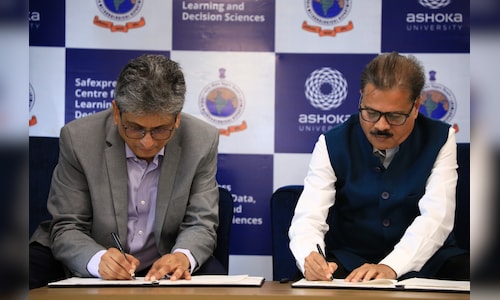

The partnership aims to combine IMD’s extensive operational datasets with Ashoka University’s analytical and computational expertise to develop better forecasting tools.
Areas of focus include predicting extreme weather events, assessing climate variability, improving monsoon forecasts, studying air quality, and evaluating climate adaptation strategies.
As part of the agreement, the two institutions will work together on curriculum design, lectures, fieldwork, and project guidance, as well as facilitate student and researcher internships at IMD.
They will also design machine learning and dynamical models for weather and climate applications, validating them using IMD’s historical records and Ashoka’s computational infrastructure.
Also Read: OpenAI’s push into education is a catalyst, not a threat: Coursera CEO
Dr Mrutyunjay Mohapatra, Director General of IMD, said the collaboration would help build better knowledge systems: “This partnership is set to benefit both institutions… together, we can develop better tools, models, and knowledge systems that will benefit society at large.”
Somak Raychaudhury, Vice-Chancellor of Ashoka University, added: “By leveraging IMD’s extensive data and expertise, we will contribute to advancing climate science, improving weather forecasting, and preparing communities to adapt to the challenges of a changing environment.”
The collaboration will also focus on capacity building, organising workshops and training in meteorological data analysis and computational methods. A Joint Steering Committee will oversee progress and coordination between teams.
Ashoka University’s Safexpress Centre for Data, Learning and Decision Sciences will anchor the initiative, reinforcing its focus on data-driven research with social impact.