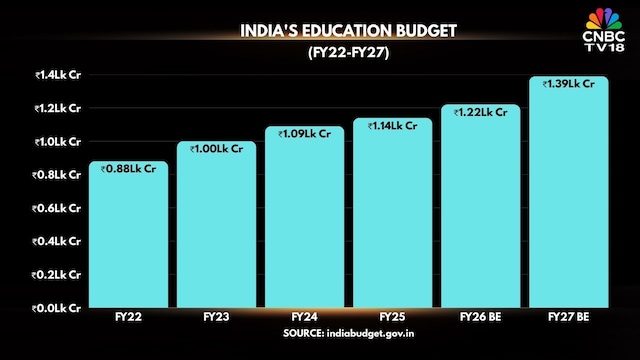

The Department of School Education and Literacy received an outlay of ₹83,562 crore, while Higher Education was allocated ₹55,727 crore. The PM-POSHAN (Mid-Day Meal) Scheme, which provides nutritious meals to students in elementary classes, received ₹12,750 crore, which is 20% higher than the revised estimate for FY26. The PM Internship scheme, first announced in the Budget for 2024-25, was allocated ₹4788.45 crore for the upcoming financial year.
The outlay for PM SHRI, an initiative to transform government schools into modern institutions, stood at ₹7,500 crore, compared to an expenditure of ₹4,500 crore in FY26. Meanwhile, Samagra Shiksha Abhiyaan, the National Education Mission aimed at ensuring equitable access and learning outcomes, received an allocation of ₹42,100 crore.
The Union Budget on Sunday, February 1, proposed setting up three new institutes for Ayurveda, alongside plans to upgrade laboratories and AYUSH pharmacies to support education and exports of Ayurveda products.
To boost design and creative education, the she announced a new National Institute of Design (NID) in the eastern region. She also announced support for the Indian Institute of Creative Technologies to set up Animation, Visual Effects, Gaming and Comics (AVGC) content creator labs in 15,000 schools and 5,000 colleges nationwide.
Additionally, three new All India Institutes of Ayurveda and three new National Institutes of Pharmaceutical Education and Research will be established.
Finance Minister Nirmala Sitharaman laid out an expansive roadmap to strengthen India’s education ecosystem, also proposing the development of five university townships along industrial corridors, intended to strengthen academia–industry linkages, and announced the construction of one girls’ hostel in every district to improve access to higher education for women.
The Finance Minister also proposed reducing the Tax Collected at Source (TCS) rate on overseas education and medical expenses under the Liberalised Remittance Scheme from 5% to 2%. This move is expected to provide relief to students and families remitting funds abroad for education and healthcare.
Additionally, the government also plans to set up or upgrade four Telescope Infrastructure facilities, aimed at strengthening scientific research and providing students and researchers access to advanced observational tools.
Read more: Budget 2026 Live Updates
The government proposed a total education budget of ₹1,39,289 crore for FY27, up 14.22% from ₹1,21,949 crore in the revised estimates for FY26.

Prof. Indranil Manna, Vice Chancellor, Birla Institute of Technology, Mesra, says, “Budget 2026’s announcement of a new National Institute of Design in eastern India, along with the establishment and upgradation of four telescope infrastructure facilities for astronomy and astrophysics, underlines the growing importance of multidisciplinary education.”
“Combined with sustained investment in AI, quantum technologies, and deep-tech research, these measures create pathways for students to engage in high-impact, future-oriented careers,” he added.
The Union Budget 2026 continues the government’s focus on strengthening education, building on the previous year’s investments in science, technology, and digital education, with 50,000 Atal Tinkering Labs planned in schools over five years, broadband connectivity for rural schools under the BharatNet project, and a Centre of Excellence in Artificial Intelligence announced in Budget 2025.