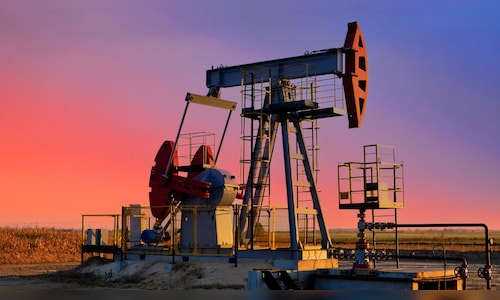

Brent crude fell towards the $111 per barrel mark, while West Texas Intermediate (WTI) or the US crude variant fell towards $98 after testing levels of $100 a barrel yet again.
US President Donald Trump, over the weekend, threatened Iran to “fully open, without threat” the Strait of Hormuz within 48 hours or have its power plants bombed, starting with its largest one.
In response, Tehran has warned that all energy, information technology, and desalination infrastructure, belonging to the US-Israel regime in the region will be hit if fuel sites are targeted.
Brent, the global benchmark, has surged more than 50% since the start of the war, that has now entered its fourth week, with no signs of easing. Prices are also volatile due to the constant flip-flop by Trump, who, before issuing his 48-hour ultimatum, said that the US is considering “winding down” the military efforts against Iran.
“Now with this 48-hour deadline, Trump has posted himself into a corner,” said Rory Johnston, oil market researcher and founder of Commodity Context Corp. “It is highly unlikely that Tehran will agree to Trump’s terms on such an accelerated timeline under the threat of attack. And Iran is clearly able and willing to match any escalation.”
Recently, the US has also allowed the sale of Iranian oil and petrochemicals which has already been loaded on to tankers. This can be sold through April 19. This follows earlier easing of selling Russian oil already at sea.
Petroleum Products have rallied more than crude itself, with Jet Fuel prices crossing $200 a barrel, airlines have already warned of higher fares from April.
Both Goldman Sachs and Citi have warned that if the conflict continues, the prices of crude could surpass their record high of $147.5 a barrel, hit in 2008, in the coming weeks.
(With Inputs From Agencies)