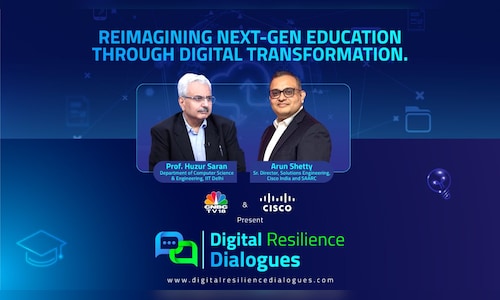

Resilience has become the invisible backbone of higher education, maintaining continuity and fostering trust within the campus community. This sets the stage for CNBC-TV18 and Cisco to present Digital Resilience Dialogues, featuring leaders from across the economy reimagining their organisations as secure, agile, and prepared for the future.
The next session brought together Professor Huzur Saran, Department of Computer Science and Engineering, IIT Delhi, and Arun Shetty, Senior Director, Solutions Engineering, India & SAARC, Cisco, in conversation with Shruti Mishra to discuss how resilience is being woven into the very fabric of India’s campuses.
Redefining resilience
Disruptions can take many forms, including cyberattacks, outages, or accidental code updates. The real question isn’t if they will happen, but how quickly systems can adapt and recover. For a university, this becomes immediate and personal. Exams must stay on schedule, lecture capture must continue, and sensitive student data must remain protected. Resilience, once seen as a back-office concern, is now directly related to the student experience.
From wired to wireless worlds
IIT Delhi’s story reflects the transformation of campuses nationwide. Just 15 years ago, having internet meant a wired connection in each hostel room, geared towards desktops rather than mobility. As devices proliferated and learning became more fluid, that setup started to break down. The institute adopted high-density wireless in crowded living spaces, investing in infrastructure that could keep up with phones, laptops, and tablets constantly in motion. What began as convenience soon became a cornerstone of academic life.
This shift also altered the security perimeter. With everything connected, the network must recognise who or what is connecting and allocate access accordingly. Students, faculty, staff, and visitors all coexist on the same system, so segmenting by identity is now crucial. Security has evolved into a design principle: seamless for legitimate users, but frustrating for intruders.
Building for the AI Age
The next wave of resilience is already underway. As campuses integrate artificial intelligence, their data centers need to be reimagined for model training, real-time analytics, and new ways of collaboration. Physical boundaries no longer limit classrooms and workplaces; professors teach remotely, students join from different geographic locations, and devices proliferate across all levels of activity. Resilience now requires not just connectivity, but the ability to secure every interaction, regardless of its source.
For institutions, the challenge is to prepare students for a future shaped by AI while ensuring that technology stays like a tool, not a crutch. Updating curricula, providing exposure to advanced systems, and developing the judgment to use them responsibly are all part of resilience by design. The ability to think critically, rather than blindly rely on algorithms, becomes a skill as valuable as any credential.
Going beyond technology: culture and collaboration are key
Resilience relies on how quickly people can adapt and how easily teams can work together across different areas. Security teams need to collaborate with IT, networking, and operations as one cohesive unit. The pandemic has shown us that flexible institutions could pivot quickly, maintain continuity, and even uncover new strengths.
Academia, industry, and government all play a role in shaping what’s to come. From 6G research to national cloud frameworks, from AI in education to rural innovation, universities like IIT Delhi are at the heart of the policies and platforms that will define India’s digital future. By building resilience into protocols, standards, and missions from the start, we can protect not just data but also our sovereignty.
The lived result
Most people on campus won’t see the dashboards that make resilience happen. They’ll notice it in more subtle ways, like a seamless Wi-Fi handoff that doesn’t drop during a lecture, a secure exam system that runs seamlessly, or a research upload that finishes on time. The best resilience is often invisible, only noticeable as time saved for learning and a sense of calm in daily routines.
The future-ready campus doesn’t call attention to itself. It simply operates smoothly. By doing so, it allows students, faculty, and researchers to focus on what truly matters: knowledge, discovery, and the potential of ideas moving freely through a network built on trust.