
“We are around 30 to 45 days away. So yes, we are still targeting listing by July,” managing director Ankit Agarwal said.
Under the project, Sterlite and Dilip Buildcon will build, operate, and maintain the broadband network in the region.
For the January-March 2025 quarter, the company reported a consolidated net loss of ₹40 crore, narrowing from ₹82 crore a year ago, while revenue rose 25% to ₹1,052 crore from the previous year.
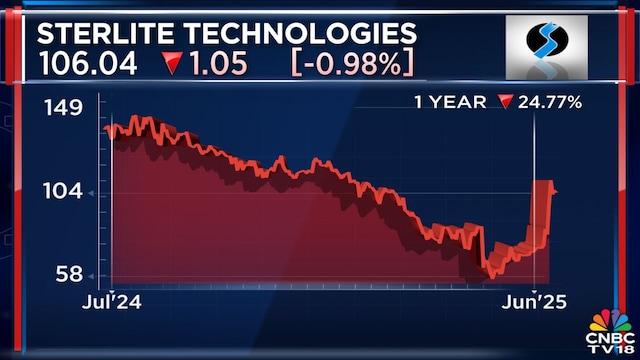
The company’s current market capitalisation stands at ₹5,174.06 crore.
Below are the edited excerpts of the interview.
Q: What is Sterlite’s role in the ₹2,631 crore BSNL project, and how is it structured?
A: This is a very important win for us. The project is being executed by Sterlite Networks Limited, under the brand ” Invenia,” and it’s a three-year construction contract followed by a 10-year maintenance period. We have previously built a 10,000 km network in Jammu & Kashmir for the Indian Army, and this time we are providing high-speed broadband connectivity to every village in the region. Sterlite Technologies Ltd. (the listed entity) will supply optic fibre cables and connectivity components for this project and other future BharatNet Phase III projects.
Q: What portion of revenue will STL recognise from this project?
A: Typically, in such projects, the optic fibre cable component accounts for about 5% to 10% of the overall project capex. One thing to highlight is that the Indian market – especially BharatNet Phase III — will be an important growth driver. Both telecom operators are adding fibre for 5G networks as well as fixed wireless. We are also seeing increased fibre demand from data centres. So, with BharatNet Phase III — both centre-led and upcoming state-led projects — we expect meaningful growth in Indian demand.
Q: So, if I heard you correctly, 5-10% max of project capex cost will be revenue recognition for your company — not for the demerged entity that signed the order. Is that correct?
A: Yes, that’s correct.
Q: And how about revenue throughout the project lifecycle? Since it’s a three-year build and a 10-year operation and maintenance (O&M) contract, does revenue continue similarly?
A:
Most of the optic fibre usage is upfront — during the first two to three years. During the O&M phase, there’s some minor usage of fibre for repairs and maintenance. But the majority of revenue comes during construction. This applies not just to this project in Jammu & Kashmir, but also to other bids under BharatNet Phase III.
Also Read | Sterlite Tech shares are up 40% in the last two trading sessions; Here’s why
Q: Will this be margin-accretive or margin-dilutive for Sterlite Tech?
A: This will be margin-accretive. It is positive for our growth. Currently, we are operating at about 50% factory utilisation. With growth from India, the US, and Europe, we expect utilisation to go above 70%. Historically, when we cross 70%, EBITDA margins rise from the current 13-15% range to about 18-20%. We are on that journey now over the next two to three quarters, and we are very excited about it.
Q: So the 18% EBITDA margin — by when do you expect to achieve that?
A: Directionally, we believe we will reach that by the end of the year. We are also focusing on the data centre segment, where we have just launched our full portfolio. We are the first Indian company to do so, and we are excited to bring these solutions to India and globally.
Q: How do you see growth from the data centre segment? What is the expected incremental revenue?
A: With GenAI-based data centres, you need 10–15x more optic fibre within the facility. Today, data centres account for 5–6% of optic fibre demand, and we expect that to go up to 20–25% in the next few years. These are high-tech, specialised solutions, typically bought as full packages of cable and connectivity.
Our goal is for 25% of our revenue to come from enterprise and data centre segments. We think it will take one to two years to get there, but it is an important milestone. We have our own IP, our own partnerships, and strong ambitions – both in India and globally.
Q: Now that the government is pushing for public-sector telecom adoption, could we expect more partnerships like this with BSNL? And in such cases, will work go to STL Networks or Sterlite Tech?
A: The objective of the demerger and the listing of Sterlite Networks is to create two distinct entities. Sterlite Technologies Ltd. is the manufacturing company, and Sterlite Networks Ltd. is the services and system integration business. The separation is intentional. That said, they could collaborate on projects on an arm’s length basis — like STL supplying products to Networks’ projects.

Q: You mentioned 25% of revenue from enterprise and data centres. What impact will that have on your topline growth this year and next? Also, when will the demerged entity be listed, since you had indicated June or July earlier?
A: We do expect topline growth, but more importantly, this is a high-margin segment. Peers in this space see EBITDA margins of 27–35%, and that is what we are targeting. Regarding the listing, we are around 30 to 45 days away. So yes, we are still targeting listing by July.
For more, watch the accompanying video