
In India, the NSE Nifty index has also bounced back and is about 5% below its peak. Most global indices have posted gains over the past month, with the tech-heavy Nasdaq emerging as the standout performer.
| STOCKS REBOUND | ||
| Index | 1 month (%) | YTD (%) |
| Dow | 8.97% | 0.26% |
| S&P-500 | 12.79% | 1.30% |
| Nasdaq | 17.96% | -0.52% |
| DAX | 12.08% | 19.38% |
| FTSE 100 | 4.94% | 6.26% |
| CAC 40 | 8.25% | 6.86% |
| Nikkei 225 | 8.71% | -5.37% |
| Shanghai Composite | 2.77% | 0.47% |
| Hang Seng | 9.11% | 16.38% |
| Taiwan | 12.63% | -5.17% |
| KOSPI | 5.78% | 9.48% |
| Nifty | 4.90% | 5.82% |
| BSE Sensex | 4.81% | 5.36% |
Foreign institutional investors have turned net buyers in India, further boosting market sentiment. After net selling equities worth over ₹1.16 lakh crore in the first quarter of the year, they have infused nearly ₹23,000 crore in April and May so far. The rally has also brought back large block deals, such as those in Bharti Airtel and JSW Infrastructure last week. Meanwhile, the primary market has shown signs of revival, with the first mainboard IPO of the year, Ather Energy, successfully closing its issue.
| FPI REVERSAL | |
| Month | Net Flow (Rs cr) |
| January | -78027 |
| February | -34574 |
| March | -3973 |
| April | 4223 |
| May | 18620 |
Source: NSDL
Can the Rally Continue?
That is the question on many investors’ minds. To answer it, one must understand the recent catalysts and assess what lies ahead.
Trump Tones It Down
US President Trump shocked global markets with his aggressive tariff stance, threatening to disrupt the world trade order. However, it now appears this was a strategy to bring countries to the negotiating table. A trade agreement with the UK and a 90-day easing in trade tensions with China indicate that while the US will likely continue to push for tariffs and concessions, major supply chains are unlikely to be severely disrupted. Even the recent bill proposing drug prices be linked to those in favoured nations was significantly diluted from its original draft.
Trump’s projection of big wins in the Middle East is also helping him frame his policies as successful. This may allow him to ease up on more disruptive trade actions.
Domestically, Trump can shift blame for any economic deterioration or credit rating downgrades—like Moody’s recent move—onto predecessor Joe Biden.
Rating Cut: Expected, Not Shocking
On Friday, Moody’s downgraded the US sovereign rating from Aaa to Aa1 and changed the outlook from negative to stable. While this is a negative development, concerns about the US’s deteriorating fiscal health have been long-standing. This has already prompted a shift of capital from the dollar into gold. As such, the market reaction may be muted given that the news was largely anticipated.
More significant is Moody’s assessment of the outlook. The agency stated: “Successive US administrations and Congress have failed to agree on measures to reverse the trend of large annual fiscal deficits and rising interest costs… We expect larger deficits over the next decade as entitlement spending rises, while government revenue remains flat. This will drive debt and interest burdens higher, weakening the US’s relative fiscal performance compared to its past and to other highly rated sovereigns.”
This may divert flows from the US to high-rated European economies and risk-reward emerging markets.
India: Poised, But Yet to Fire
The Reserve Bank of India (RBI) has revised India’s FY26 growth forecast to 6.5%, down from 6.7%, citing global uncertainties. With some of those headwinds easing, the economy may outperform this estimate. The RBI already expects growth to pick up to 6.7% in FY27. A revival in global trade, along with India capitalising on its trade deal with the UK and broader supply chain shifts, could enhance export opportunities.
India’s IT services sector, closely linked to US business sentiment, may see quick upside. While deal wins have remained strong, growth has slowed due to earlier uncertainty. A rebound could boost India’s consumption-driven economy.
Capex and Housing on Track
Key growth drivers like infrastructure and housing are on a solid footing. After a slow FY25, the Indian government has increased capital expenditure for FY26 to ₹11.2 lakh crore from ₹10.2 lakh crore (FY25 revised estimate). In housing, despite concerns over a slowdown, most developers remain upbeat.
Pavitra Shankar, MD of Brigade Enterprises, told CNBC-TV18: “We are still seeing strong demand across mid, upper-mid, premium and super-luxury segments and have guided for 15% YoY growth in pre-sales for FY26.” Signature Global’s CEO, Rajat Kathuria, added: “We are not seeing any softness in NCR demand and expect 20% YoY growth going forward. Prices will continue to rise due to limited supply.”
Godrej Properties CEO Gaurav Pandey noted: “There’s been a lot of negative talk in the media, but our numbers mostly depend on getting timely launch approvals. We ended the year with a strong ₹10,000 crore figure. Our wide geographic spread and diversified offerings are driving strong demand. Wealth creation and aspiration are fuelling growth in India.”
Construction and Ancillary Demand Up
India’s real estate sector appears healthy, which should keep construction activity robust. This is visible in large cities, with redevelopment also gaining pace in places like Mumbai. The associated demand for construction materials and home products is expected to remain strong.
Wealth Effect in Play
The equity market rebound and rising investor optimism should continue to support premium and luxury consumption. Rural demand is also recovering, though companies remain cautious about a full urban revival. A weak job market is likely weighing on urban consumption. A broader business expansion, prompted by recent geopolitical disruptions, could rejuvenate demand both domestically and internationally.
India now has access to technology, capital, land, labour and entrepreneurial talent. With an enabling policy environment and growth ambition, India has the potential not just to be among the world’s largest economies, but also to lift per capita income significantly while reducing inequality—initiating a virtuous growth cycle.
Valuation Concerns Persist
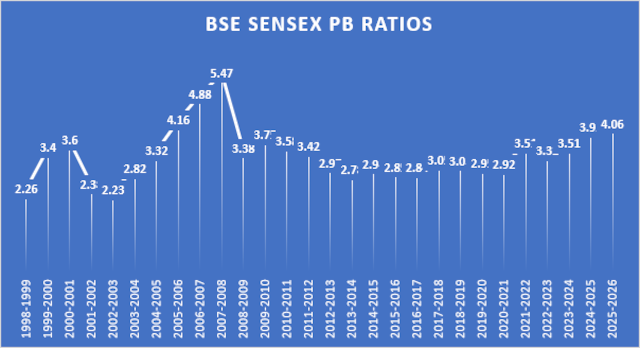
For markets to sustain momentum, growth must materialise. The recent rally has stretched valuations again. Amid global uncertainty, many are wary of forecasting economic outcomes. One prudent approach is to evaluate valuations using historical price-to-book ratios. On this metric, the BSE Sensex’s current valuation—above 4x—is elevated. That said, such levels have been breached in the past, notably during the 2005–08 bull run.

Even without any euphoria, the low leverage levels of Indian corporates today provide room for significant expansion in earnings, return on equity, and net worth—factors that could help bring down future market valuations. Consequently, the direction of the market will now be heavily influenced by incoming growth signals, especially as elevated valuations increase the risk of a correction in the event of any disappointments.
For investors, while this may not be the ideal time to increase exposure to the market, there is no immediate need to exit either. Markets often surprise on both the upside and downside, so it’s best to wait for clearer signals before making any decisive moves.
Happy investing!