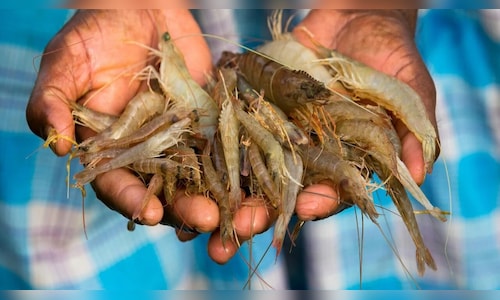

From giant katla held aloft at roadshows to ilish, pabda and chingri finding pride of place in political speeches, fish has emerged as an unlikely but potent metaphor in West Bengal’s assembly polls, turning food habits into a fierce contest over identity, culture and who represents the “real” Bengali.
The old Bengali phrase ‘mache bhate Bangali’, which means a Bengali is defined by the consumption of fish and rice, has become this election’s de facto slogan for the parties.
The TMC has sought to weaponise the sentiment by arguing that the BJP, which it seeks to associate with Hindi speakers and vegetarianism-promoting politics of North India, is culturally alien to West Bengal and, if voted to power, could eventually impose restrictions on fish, meat and eggs.
Chief Minister Mamata Banerjee sharpened the attack at a rally by saying, “They will not let you eat fish. You cannot have meat, you cannot have eggs, you cannot speak in Bengali. If you do, they will call you Bangladeshi”, thus linking food, language and Bengali identity into one political argument.
Also Read: Iran US War Live Updates
The allegation has allowed the TMC to move the campaign away from anti-incumbency, corruption and unemployment and towards a terrain where it feels more comfortable — Bengali sub-nationalism. Fish, in that telling, is no longer merely lunch. It is a badge of Bengali pride.
The party’s social media handles have posted photographs of delicacies like ilish bhapa, pabda jhal, chingri malai curry and kosha mangsho after Union Home Minister Amit Shah announced he would spend 15 days in West Bengal for campaigning.
“West Bengal welcomes tourists. Do not miss our delicacies,” one TMC post said, in a swipe at Shah that mixed sarcasm with culinary nationalism.
Political analyst Maidul Islam said the TMC sees West Bengal “essentially as a Bengali project”.
“Within that Bengali project, fish-eating is an important element. When fish markets are attacked elsewhere, or Hindi-speaking leaders wrinkle their noses at fish, it becomes a campaign point. The TMC is saying it is the organic party of Bengalis and therefore organically linked to Bengali food habits,” he said.
That argument has acquired traction because West Bengal’s relationship with fish goes far beyond cuisine.
Also Read: Good Friday observed with prayers in Kerala, poll candidates visit churches
In West Bengal, fish is part of every important moment in life — from a baby’s first rice-eating ceremony and the gift sent to a groom’s house before a wedding to the meal that marks the end of mourning after a ‘shraddha’.
According to World Bank data, West Bengal consumes 8.36 lakh tonnes of fish annually, nearly twice the national average, while fish and meat together account for almost a fifth of household food expenditure in the state.
The BJP insists the TMC is deliberately manufacturing fear. Its leaders point out that there is no proposal to ban fish or meat in West Bengal and accuse the ruling party of trivialising the election by reducing it to a menu card.
Yet, significantly, the BJP now finds itself having to publicly prove that it is not anti-fish.
Bidhannagar BJP candidate Sharadwat Mukherjee recently campaigned carrying a five kg katla fish through neighbourhoods, telling voters that the BJP would never interfere with Bengali food habits.
In Pandaveswar, BJP candidate Jitendra Nath Tiwari filed his nomination papers accompanied by a “fish procession”, with supporters carrying baskets of fish while he himself held a large one.
“If promoting West Bengal’s culture is drama, I am proud of this drama,” Tiwari said.
The spectacle was politically revealing. For years, the BJP projected vegetarian symbolism in many Hindi heartland states. In West Bengal, however, the same party is now campaigning with fish in hand.
Also Read: Iran drafting proposal to ‘monitor’ Strait of Hormuz with Oman
Political analyst Suman Bhattacharya said that itself showed how deeply the TMC narrative had penetrated.
“The perception that the BJP is against fish and non-vegetarian food has become so strong that party leaders now have to publicly eat fish and campaign with it. That itself shows how their vegetarian politics elsewhere didn’t work in West Bengal,” he said.
State BJP president Samik Bhattacharya has been equally emphatic.
“There is no question of banning fish. Bengalis will eat fish and Biharis will eat mutton. If anyone tries to stop me, I will resist,” he said, while accusing the TMC of spreading misinformation.
The BJP’s discomfort stems partly from events outside West Bengal.
Remarks by Bihar Deputy Chief Minister Vijay Kumar Sinha about restricting the open sale of meat near schools and religious places, together with repeated controversies in BJP-ruled states over meat shops, fish markets and vigilante attacks, have fed the TMC narrative.
In January, a vendor was allegedly assaulted by right-wing activists for selling chicken patties near a religious gathering in Kolkata. Earlier, there had been controversies over temporary meat bans during Navratri and over fish markets in Delhi.
For many Bengalis, these episodes reinforce the fear that a more homogenised, North Indian, vegetarian-first cultural model could one day be imposed on West Bengal.
A Kolkata-based Indologist said fish occupies a civilisational space in West Bengal.
Also Read: Raghav Chadha shares video detailing Rajya Sabha arguments in response to AAP snub | WATCH
“For Bengalis, fish is not merely food. It is memory, ritual and identity. To challenge that is to appear alien to West Bengal itself. And in Hindu scriptures, there is no mention of vegetarianism being linked to religious identity,” he said.
Kaushik Maiti of a Bengali nationalist outfit Bangla Pokkho said, “Fish is very much part of Bengali identity. But the BJP wants to impose the vegetarian food culture of North India, we are opposed to it.”
As the campaign intensifies, West Bengal’s electoral battle is increasingly being fought not merely over SIR of electoral rolls, jobs, corruption or governance, but over Bengali identity. In that battle, the humble fish has swum to the centre of West Bengal’s political pond.