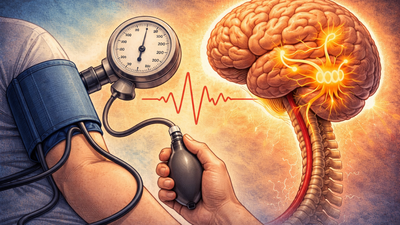


Researchers have just discovered something surprising about how your body controls blood pressure. It turns out that a tiny cluster of neurons in your brain that controls your breathing is also controlling your blood pressure and when these neurons go haywire, it can cause dangerous high blood pressure that’s hard to treat.The findings of the study done by a team from the University of São Paulo in Brazil and the University of Auckland in New Zealand have been published in the journal Circulation Research.This finding could change how doctors treat millions of people with high blood pressure that doesn’t respond to medication.
The problem: High blood pressure that won’t go away
Here’s the thing about high blood pressure. About 40% of people taking medication for it still have high blood pressure. They’re on pills, they’re following diet advice, but their numbers just won’t come down. Doctors call this “treatment-resistant hypertension,” and it’s one of the biggest unsolved problems in modern medicine.A team of researchers from Brazil, New Zealand, and other institutions decided to look deeper. They asked a simple question: what if there’s a specific part of the brain that’s driving this excessive sympathetic activity?
The discovery: Breathing neurons control blood pressure
The researchers focused on an area of the brainstem called the lateral parafacial region. This area is known for controlling breathing. But they had a hunch that it might also be connected to blood pressure control. So they set up an experiment using rats with high blood pressure.They used some high-tech tools. One technique called optogenetics lets scientists activate specific neurons using light. Another called pharmacogenetics lets them quiet neurons down using special drugs. This meant they could turn specific neurons on and off and watch what happened.
Image: AI
Here’s what they found: when they turned on the lateral parafacial neurons, the animals started breathing out more actively (active expiration), and at the same time, their blood pressure went up. More importantly, they discovered that these breathing neurons were sending signals directly to other parts of the brain that control the sympathetic nervous system. When these neurons were active, they were telling the sympathetic system to be more aggressive.
The real problem: Overactive breathing neurons
The researchers discovered that in hypertensive rats (ones with high blood pressure), these breathing neurons were particularly hyperactive. And the connections between breathing neurons and blood pressure control neurons were stronger than normal.Then the researchers used pharmacogenetics to quieten down the lateral parafacial neurons in hypertensive rats. What happened? The excessive sympathetic activity stopped. The rats’ blood pressure normalized. The expiration-related blood pressure surges disappeared.This means that simply reducing the activity of these breathing neurons fixed the problem that drugs couldn’t fix before.The implications are enormous. If researchers can figure out how to target these specific neurons in humans—either with new drugs or other treatments—they might be able to help the millions of people whose blood pressure won’t respond to current medications.What’s remarkable about this research is that it highlights something important about neuroscience. Your brain is interconnected in ways we’re still discovering. The system that evolved to help you breathe is directly connected to the system that controls your circulation. When one goes wrong, it affects the other.