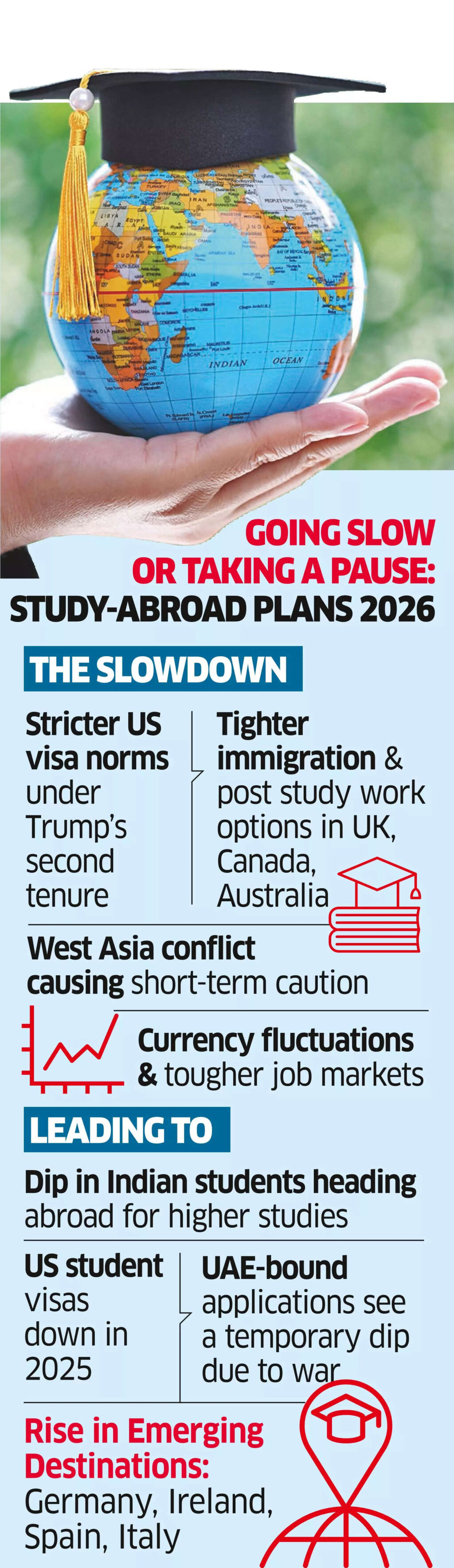

New Delhi: Stricter visa policies in the United States, especially under Donald Trump’s second tenure, tighter immigration rules and reduced post-study work options in the United Kingdom, Canada and Australia, as well as the ongoing West Asian conflict are forcing many Indian students to stall or rejig their overseas education plans, consultants said.
In recent months, many students have deferred their plans to the next intake season at foreign universities, while quite a few are exploring options closer home or more stable destinations amid global unrest and uncertainty.
Adarsh Khandelwal, cofounder and director, Collegify, said, “There is a noticeable cooling-off in study-abroad trends. Government data shows that Indians travelling abroad for study fell from 908,000 in 2023 to 626,000 in 2025, which is a very meaningful drop.”
India, he added, is no longer being treated only as a fallback but is increasingly being evaluated as a serious first-choice ecosystem.
Parents are making more calculated decisions before sending their wards abroad, according to experts. The larger concern among students, they added, is policy uncertainty – not the war.
“Recent official statistics from major destinations suggest that international mobility of students is slowing down compared to the previous year,” said Piyush Kumar, regional director-South Asia, Canada & LATAM at IDP Education. For instance, US department of state data shows that student visas issued to international applicants dropped by 62% between June and July 2025.
“There are multiple factors contributing to the decline, including tighter visa policies, tougher job markets for fresh graduates and currency fluctuations,” according to Kumar.
The postgraduate segment has been more affected. “Many aspirants are working executives who prefer to postpone their study plans by a year or two,” Kumar added. They are waiting for the current turbulence to settle.
Recalibrating Choices
There has also been a temporary fall in UAE-bound applications because of the ongoing security situation in the region, according to consultants.
“At a macro level, demand for international education in 2026 reflects a phase of recalibration and diversification in destination choices, rather than any structural decline,” said Akshay Chaturvedi, founder and CEO, Leverage Edu.
“When there is conflict, travel advisories or constant media coverage of instability, it changes the emotional temperature in households,” said Khandelwal of Collegify.
Saurabh Arora, founder & CEO of University Living, said some students were opting for strong domestic institutions or international programmes delivered within India, while others were still pursuing full degrees abroad.
“What we are seeing on the ground is not students withdrawing from their plans, but taking slightly longer to finalise their decisions,” Arora said.
Students and parents are spending more time evaluating destinations, costs and career outcomes, experts said. Visa rule changes, rising education costs and shifting post-study work opportunities have already made families more cautious over the past year or two.
Meanwhile, several global universities—including the University of Southampton and Deakin University—have started setting up campuses or partnerships in India. “India is also becoming a more visible education destination itself,” Arora said.
Experts also pointed to a shift from traditional destinations such as the US, Canada, the UK and Australia to countries like Germany, Ireland, Spain and Italy.