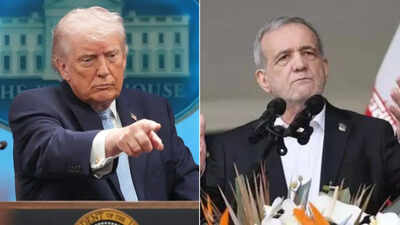


The White House announced on Wednesday that US President Donald Trump will send a high-level delegation led by Vice President JD Vance to Islamabad this weekend for talks with Iran aimed at securing a more durable ceasefire.“I can announce that the President is dispatching his negotiating team, led by the Vice President of the United States, JD Vance, Special Envoy Witkoff, and Mr Kushner, to Islamabad for talks this weekend,” White House press secretary Karoline Leavitt said.The first round of those talks will take place on Saturday morning, local time, and we look forward to those in-person meetings,” Leavitt added.Iranian president Masoud Pezeshkian has also confirmed Tehran’s participation in upcoming talks where both sides are expected to hold direct negotiations aimed at ending weeks of intense hostilities following the outbreak of war.Who is likely to attend the talks in Islamabad?Pakistani officials have shared a tentative list of participants expected to take part in the upcoming talks aimed at ending the conflict between Iran and the United States, according to Al Jazeera. As host and mediator, from Pakistan, Prime Minister Muhammad Shehbaz Sharif is expected to be involved, along with Army Chief Syed Asim Munir, Deputy Prime Minister and Foreign Minister Ishaq Dar, and National Security Advisor Lt Gen Asim Malik.The US delegation is likely to be led by Vice President JD Vance, accompanied by Special Envoy Steve Witkoff and former senior adviser Jared Kushner, with CENTCOM Commander Admiral Brad Cooper also expected to attend.Iran’s delegation is expected to include Parliament Speaker Mohammad Bagher Ghalibaf, Foreign Minister Abbas Araghchi, and Deputy Foreign Minister Majid Takht Ravanchi, the report added.Ceasefire backdrop and stakesThe White House quietly worked behind the scenes to broker a temporary ceasefire with Iran, even as Trump publicly escalated his rhetoric, claiming Tehran was “begging” for a deal, according to people familiar with the discussions who spoke to the FT.The talks are taking place during a fragile two-week ceasefire announced by Trump to create space for negotiations. While the pause has reduced direct confrontation between the United States and Iran, violence continues, particularly in Lebanon.Israeli Prime Minister Benjamin Netanyahu also signalled a parallel track, ordering preparations for direct talks with Lebanon focused on disarming Hezbollah, even as military operations continue.His remarks came a day after his first briefing since the US-Iran ceasefire, where he underlined that the truce remains fragile, asserting it is “not the end” and that Israel retains the option to resume military action if its objectives are not met. Striking a cautious tone, Netanyahu said Israel has its “finger on the trigger” and is ready to “return to battle at any moment” if required.Despite the diplomatic push, there has been no let-up in violence. According to Lebanese health authorities, at least 203 people were killed and over 1,000 wounded in Israeli strikes on Wednesday. Hezbollah said it was engaged in close-quarter fighting with Israeli forces in the southern town of Bint Jbeil on Thursday.Netanyahu’s directive to initiate talks with Lebanon is aimed at disarming Hezbollah and establishing peace, according to his office, but it offers no immediate pause in hostilities.A Lebanese government official told AFP that Beirut is not ready to engage without a cessation of violence. “Lebanon wants a ceasefire before starting negotiations,” the official said, requesting anonymity.Uncertainty remainsWhile Islamabad is set to host the first round of in-person talks, Pakistani officials told Al Jazeera that the key details of the discussions, scheduled for Saturday in Islamabad, are still being finalised and the list of attendees could change.Adding to the uncertainty, Iran’s ambassador to Pakistan, Reza Amiri Moghadam, briefly posted on X that an Iranian delegation would arrive “tonight in Islamabad for serious talks based on 10 points proposed by Iran,” before deleting the message shortly after.An embassy official later told AFP the post had been shared prematurely, saying it was removed due to “some issues” and clarifying, “Timing, we were not supposed to send it.”