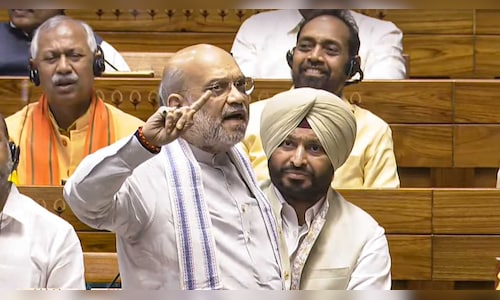

Replying to the debate on the Bill, Shah said, “India is not a dharamshala (resthouse).”
The bill was passed by a voice vote after various amendments moved by Opposition members were negated.
“This is very important. The main issue is that the immigration is not an isolated subject, but it is directly or indirectly linked to various issues. The bill will ensure a close monitoring of everyone who visits India, why they visit India and how long they want to stay in India. It is necessary to know the details of every foreigner visiting India,” he said after the over three-hour-long debate.
Here are the key highlights of the Bill
- Anyone found to be using a forged passport or visa for entering India or staying in or exiting from the country will be punishable with a jail term of up to seven years and a fine which could extend to Rs 10 lakh.
- Any foreigner who enters any area in India without a valid passport or other travel document, including a visa, in contravention of provisions of the law or of any rule or order given in pursuance thereof, shall be punishable with an imprisonment extending upto five years or with fine of to Rs 5 lakh rupees or with both.
- Overstaying, visa violations, or trespassing in restricted areas can get up to 3 years imprisonment and a fine up to ₹3 lakh.
- Foreigners must register upon arrival, and restrictions will apply to name changes, movement, and access to protected areas.
- The Bill empowers the central government to exert control over places that are “frequented by any foreigner” and require the owner to close the premises, permit its use under specified conditions, or refuse admission to all or a “specified class” of foreigners.
- Matters relating to foreigners and immigration are presently governed through four legislations: Passport (Entry into India) Act, 1920; the Registration of Foreigners Act, 1939; the Foreigners Act, 1946; and the Immigration (Carriers’ Liability) Act, 2000. All these laws are now proposed to be repealed.
- The Bill provides for mandatory reporting of information about foreigners by hotels, universities, other educational institutions, hospitals and nursing homes to enable tracking of overstaying foreigners.
According to Union Home Ministry data, 98.40 lakh foreigners visited India between April 1, 2023, and March 31, 2024.
What Oppn said
Opposition MPs claimed that certain provisions of a Bill give “arbitrary powers” to immigration authorities and demanded that it be sent to a joint parliamentary committee for a detailed scrutiny.
Congress MP Manish Tewari said its provisions give “arbitrary powers” to the government for exempting certain categories of foreigners from the law. He also criticised a provision that makes the immigration officer’s decision final and binding in case of a dispute.
He also raised concerns over another provision that empowers immigration officers to seize damaged passports, without clearly defining what constitutes “damage”. He also questioned clauses of the Bill, which state that any foreigner suspected of wrongdoing can be arrested by any head constable and jailed for two to seven years, saying at least the power should be given to an official of the rank of an inspector.
Samajwadi Party MP Rajeev Rai backed Tewari and said the Bill was necessitating a thorough review by a committee.
Trinamool Congress MP Sougata Ray also backed the demand, asserting that Shah has introduced a stringent law. “I believe this Bill should be sent to a joint select committee as it requires a detailed examination,” he said.
With inputs from PTI