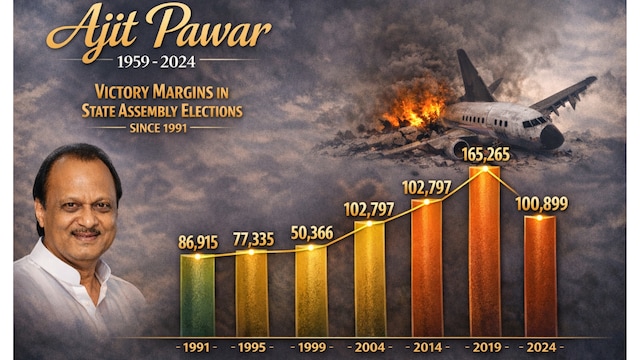

Ajit Pawar, Maharashtra’s Deputy Chief Minister and one of the state’s most influential political figures, died along with four others on Wednesday, January 28, when their VT-SSK Learjet 45 crash-landed at Baramati in Pune district, Maharashtra. He was 66.
The aircraft, carrying Pawar, a security officer, an attendant, and two crew members, was attempting a second approach when it crashed, according to the Directorate General of Civil Aviation (DGCA) and Flightradar.
A mass leader from Baramati and a central force in Maharashtra’s politics, Ajit Pawar played a decisive role in governments across party lines. Born on July 22, 1959, in Deolali Pravara, Ahmednagar district, he was the son of Anantrao Pawar, elder brother of Sharad Pawar, and was popularly known as “Dada”.
Pawar entered politics under the mentorship of his uncle, Sharad Pawar, beginning in 1982 with election to a sugar cooperative body. He served as Chairman of the Pune District Co-operative Bank from 1991 to 2007. In 1991, he was elected to the Lok Sabha from Baramati but vacated the seat for Sharad Pawar, subsequently winning elections to the Maharashtra Assembly in 1991, 1995, 1999, 2004, 2009, and 2014.
Educated partly abroad, he completed secondary schooling in the US, earned a GCSE in the UK, and passed his SSC under the Maharashtra State Board. Before entering politics full-time, he worked as a social worker in Baramati, forging local connections that would later underpin his political base.
Over the years, Pawar emerged not just as an heir to his uncle’s legacy but as a formidable political operator, known for his command over numbers, bureaucracy, and rural Maharashtra. He held key portfolios, including Minister of State for Agriculture and Power (1992–1993), Minister of Water Resources (Krishna Valley & Konkan Irrigation, three terms), and Deputy Chief Minister — first from 1991 to 1995, then 2009–2014, and finally 2019–2026.
His repeated returns to the powerful post reflected both his personal clout and his ability to navigate Maharashtra’s often volatile political landscape. He skillfully balanced shifting alliances, managed coalition negotiations, and maintained influence across party lines, making him a central figure in state politics regardless of which party was in power.

Follow LIVE UPDATES on the developing story here.
His career was not without controversy.
Ajit Pawar faced sustained allegations linked to irrigation projects during his tenure as water resources minister in the 2000s, with critics citing cost escalations and procedural lapses in major dam and canal works. These triggered audits and inquiries by oversight and anti-corruption agencies over the years, though they did not result in a criminal conviction against him, with several probes closed or remaining inconclusive.
Pawar’s public conduct often drew criticism, too. In the early 2010s, particularly during periods of drought and agrarian distress, he made a series of blunt remarks, including comments perceived as dismissive of farmers’ concerns, such as the infamous April 2013 “urinate in the dam” remark. These statements, along with occasional outbursts against critics and officials, sparked political backlash and media scrutiny. He later issued a formal apology in the Maharashtra legislature, clarifying that his words were not intended to hurt anyone’s sentiments.
Despite these storms, Pawar remained electorally formidable in Baramati and retained deep influence in Maharashtra’s cooperative and sugar-belt politics.
A decisive rupture came in July 2023, when Ajit Pawar led a breakaway faction of the NCP, joining the BJP-led alliance and triggering a formal split in the party founded by Sharad Pawar.
The move redrew Maharashtra’s political map and altered equations within both the ruling coalition and the Opposition.
In the Assembly elections held in late 2024, Pawar went on to retain his Baramati stronghold, reaffirming his enduring grip over the constituency despite the split and shifting alliances. The result reinforced his standing within the government and revived speculation about his longer-term role in the state’s power structure.
In the weeks preceding his death, Pawar shared the stage with Sharad Pawar at a public event, a rare interaction that drew wide attention amid talk of possible reconciliation or a tactical reset in the fractured NCP legacy. No formal realignment followed, but the moment was widely viewed as symbolically significant in Maharashtra’s evolving politics.
An influential-yet-controversial figure in Maharashtra politics for nearly four decades, Pawar remained at the centre of the state’s political churn, a figure whose rise, resilience, and final chapter marked the end of a defining era in public life. He is survived by his wife Sunetra Pawar and sons, Jay Pawar and Parth Pawar.