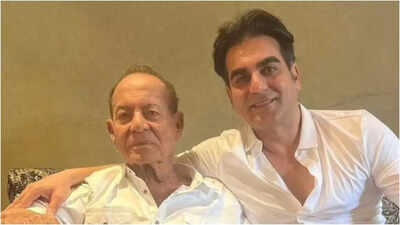


Veteran screenwriter Salim Khan is recovering well and is likely to be discharged from the hospital soon, confirmed his son Arbaaz Khan on Wednesday night. The iconic writer has been receiving treatment at Mumbai’s Lilavati Hospital for almost a month.
Arbaaz Khan gives positive update on Salim Khan’s condition
According to News18, after attending an Iftar event in Mumbai, Arbaaz offered a health update on his father, veteran screenwriter Salim Khan. The actor-filmmaker assured that his father is recovering well and showing consistent progress. “He’s better now, he’s improving,” Arbaaz told reporters. When asked when Salim Khan would be discharged, he responded with a smile, “Soon.”
Salim Khan’s medical treatment and stable condition
On February 17, veteran writer Salim Khan, 90, was admitted to Mumbai’s Lilavati Hospital after experiencing a mild brain haemorrhage. Soon after his admission, he reportedly underwent a minor procedure and has since been kept under close observation in the Intensive Care Unit (ICU). Doctors had described his condition as stable while continuing routine monitoring. Dr. Jalil Parkar, who is leading his treatment, previously stated that the family requested privacy, and no further medical updates will be shared.
Khan family breaks silence on Salim Khan’s health
Arbaaz Khan’s recent statement marks the first time the family has publicly spoken about Salim’s health since his hospitalisation. Until now, the Khans had chosen not to comment, maintaining privacy as several close friends and colleagues from the film fraternity visited the veteran writer. Previously, actors Aamir Khan, Chitrangda Singh, and Daisy Shah had assured fans through brief interactions that Salim Khan was recovering well.
Salim Khan’s legacy as a legendary screenwriter
Salim Khan is celebrated as one of the most influential screenwriters in the history of Hindi cinema. In collaboration with his long-time writing partner Javed Akhtar, he crafted several of Bollywood’s most iconic films, such as ‘Andaz’, ‘Seeta Aur Geeta’, ‘Sholay’, ‘Don’, and ‘Mr. India’. His storytelling defined an era of grand narratives in Indian cinema and continues to inspire writers and filmmakers even today.