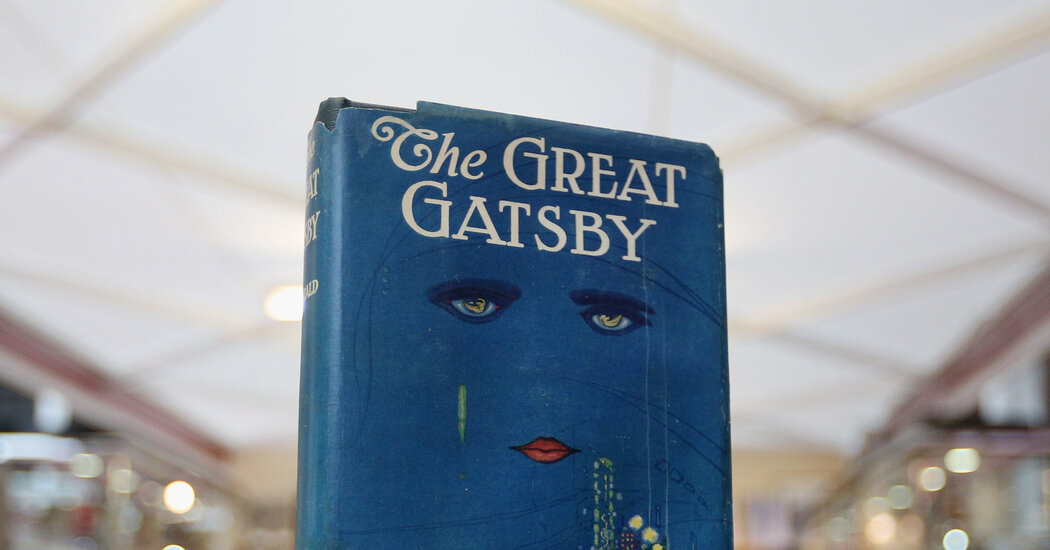

It’s romantic.
Or at least Gatsby himself is. Nick describes him in the opening pages as possessing “some heightened sensitivity to the promises of life.” But modern life — crass, dishonest and materialistic — betrays those promises and destroys Gatsby’s life. Even though he’s a rich man with underworld connections, his motives remain pure. Above all, he’s driven by his love for Daisy, his former sweetheart, now married to the repellent Tom Buchanan. The tension between Gatsby’s noble spirit and the tawdry decadence of his surroundings brings the book to life. If Fitzgerald’s social criticism were less astute, the love story might seem corny; if the romance didn’t sing, the satire would collapse into cynicism.
It’s funny.
The Jazz Age reviewers who liked the book admired it as an acid-etched portrait of the times. Fitzgerald’s eye for hypocrisy and buffoonery and his ear for puffed-up speech remain sharp. Tom Buchanan, whose awfulness has a serious, violent side, is at the same time a brutally comic takedown of a certain kind of know-it-all blowhard, still familiar a century later:
“I read somewhere that the sun’s getting hotter every year,” Tom said genially. “It seems that pretty soon the earth’s going to fall into the sun — or wait a minute — it’s just the opposite — the sun’s getting cooler every year.”
F. Scott Fitzgerald could write.
Almost too well! “Gatsby” often shifts from brisk comedy to swooning lyricism to philosophical rumination within the space of a single page, somehow keeping a steady, conversational, modern tone. Fitzgerald knows when to accelerate the narrative with clipped, telegraphic sentences and when to draw it out in flights of elaborate description. The last sentence (“And so we beat on, boats against the current, borne ceaselessly back into the past”) is justly famous, but it follows a score of others that are at least as evocative, or even more so.
It has so many great characters …
Meyer Wolfsheim, the gangster who fixed the 1919 World Series. Jordan Baker, Nick’s feline sort-of girlfriend. Old Mr. Gatz, who shows up at the end to clear up the mystery of Gatsby (but really to deepen it). And of course the central triangle of Daisy, Tom and Jay.
… and so much to talk about.
There’s a reason English teachers love this book. But even if you only read it in school — or never did — there is endless fodder for discussion and debate, much of it still remarkably current. The state of the American dream, the bedazzling and corrupting power of money, the green light at the end of the dock.
THE LATEST NEWS
The Trump Administration