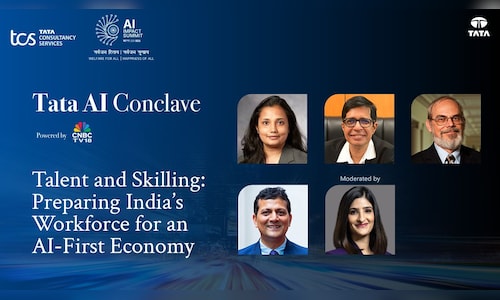

India today stands at a pivotal crossroads. It is among the world’s largest consumers and users of AI, with more employees actively using AI tools than anywhere else. Yet, confidence in AI skills remains disproportionately low. While adoption has surged across enterprises, true readiness has lagged. Compounding this challenge are projections that even as demand for AI capabilities accelerates, India could face a shortfall of nearly one million skilled professionals in the sector.
The discussion featured perspectives from Aparna Ganesh, Chief Digital Officer, Tata Sons; Prof. V. Kamakoti, Director, IIT Madras; Prof. Eric Grimson, Chancellor for Academic Advancement, MIT; and Rajiv Kumar, MD and President, Microsoft IDC. Together, they explored how academia and industry must collaborate to redesign curricula, accelerate continuous learning within enterprises, and democratise access to AI capabilities.
Are we scaling AI awareness faster than AI capability?
A primary concern for the employment pipeline is whether foundational skills are being sacrificed for speed. Prof. Kamakoti of IIT Madras argues that while AI education must be scaled through hybrid and online models to reach more people, it cannot be superficial. IIT Madras has already introduced programs that allow people at all levels to learn. Today, they have 50,000 students, ranging from ages 17 to 81. The interest is ther,e and upskilling is happening, but he cautions against treating AI training as a short-term solution, “Within two days of practising yoga you can’t say you are a yogi, right?”
Mass education is a start, but without a foundational understanding of probability, statistics, and basic mathematics, all of which take time and effort to master. AI upskilling cannot happen overnight.
MIT’s Prof. Grimson’s view is that one solution is for universities to offer much broader degrees, ones that overlap with AI: AI in economics, AI in material sciences, and so on. The idea is that such overlap and flexibility give students the ability to adapt more quickly. He also believes that it’s important for students to acquire thinking skills, the ability to structure a problem in a way that gets AI to serve you better.
“The challenge is to change the way we teach so that students think about how to ask the right question. How do I put enough structure on the problem so that the system will build something that’s valuable?”
Where do we see the skill gaps in the market today?
For corporations, the gap is not just about technical ability but also about mindset. Rajiv Kumar of Microsoft IDC notes that while the quality of AI-generated code is “mind-blowing,” it presents an existential question for the workforce. While employees are very smart, many are reluctant to learn AI or use the tools because of a perceived threat to their jobs. “It’s an existential question. Personally, I believe that AI isn’t going to take away a job; it will change the job.”
In fact, he sees the new generation of talent, people born in the age of AI, as more open. “They don’t think AI will take my job; they think AI is going to do my job.”
Large organisations like the Tata Group face the task of skilling across a massive spectrum, from senior leadership to shop-floor workers. Tata’s Aparna Ganesh describes a “persona-based” approach where senior leaders focus on the “art of the possible” and shifting cost structures, while middle management learns to reimagine business processes. On the technical front, the focus is on giving engineers a safe environment to iterate and play around in.
“AI is a general-purpose technology, and you need to be upskilling differently across different levels,” she observes. She’s also quite optimistic about AI, pointing out that while it’s possible to do more work with fewer people, the scale of businesses is also growing.
“Yes, AI will be doing your code, but the world has written just 5% of the software it needs. The pie is expanding, and we’re also reaching a lot more people.”
As Prof. Kamakoti notes, businesses grow, and toolsets expand. Banks don’t count cash by hand anymore, but they’re larger than ever and employ more people today than they did when cash was counted by hand.
Training and ethics in an AI-first world
As AI makes intelligence gathering easier, there is a risk of weakening individual competence. Prof. Grimson argues that the solution is to train students to structure a problem, to train them to think about how to ask the relevant questions. “We also need to get students to think about whether it (an AI model) gave the right answer or not. You still need to know enough of the fundamentals to be able to do that.”
In terms of ethics, he points out that it’s important to be able to “think of the right way to gather data, how to deal with it, and how to protect privacy.” For students, he believes it’s important for ethics to be embedded at a fundamental level. “In every lecture, we try to integrate 5-8 minutes of an ethical question.”
Prof. Kamakoti concurs, noting that all systems are mathematical, but observing that society runs on trust – a variable that he describes as context-dependent and temporal. He calls for a return to values-based education: “Please don’t talk about power, fame, and money to your children. Talk about ethics, talk about patriotism. That’s how we can have next-generation AI engineers for Vikshit Bharat 2047.”
The big question: Will AI create more jobs than it displaces?
On this question, the panel was unanimous: AI will change the nature of work rather than eliminate it. “AI will create more value in the world. I’ve been working with technology for 34 years, and every technology has made the world better.”
Aparna Ganesh concludes, “The roles that we see could be completely different from what we envisage today, but there will be net new jobs and our children will not be sitting at home without work.”