
He drew on his own experiences working in corporate America, including roles in banking and technology at companies such as Bank of America and Pacific Bell, to create a world of office satire recognised instantly by millions. The characters he developed reflected the frustrations, absurdities, and humour of everyday work life.
As Adams wrote in interviews, he started Dilbert because he wanted to make fun of the corporate world he was living in.

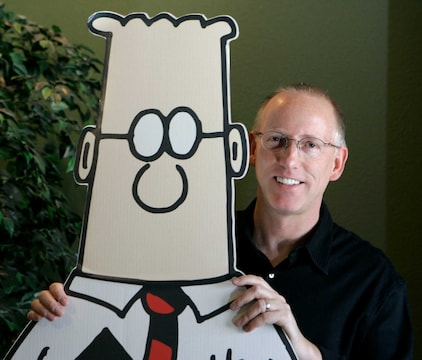
Scott Adams, creator of the comic strip Dilbert, in his studio in Dublin, Calif., Oct. 26, 2006. (AP Photo/Marcio Jose Sanchez, File)
Here’s a look at the Dilbert characters who captured office life. Which one do you identify with?
Dilbert: Dilbert is the office everyman: competent, polite, and frequently exasperated. Adams modelled Dilbert on his own experiences as an engineer in the late 1970s and 1980s. Through Dilbert, readers saw the daily grind of meetings, pointless projects, and bureaucratic absurdities.
The Pointy-Haired Boss (PHB): The PHB embodies the clueless manager: often out of his depth but in charge of everyone else. Adams drew this character from observing middle managers who lacked practical knowledge yet wielded power in his workplaces. .
Wally: Wally perfected the art of doing as little as possible without being caught. In the book
How to Fail at Almost Everything and Still Win Big, Adams noted that Wally’s behaviour was “the kind of pragmatism people develop when nothing they do changes management decisions”.
Dogbert: Ambitious, mischievous, and scheming, Dogbert provides an outside perspective on office life. Adams created Dogbert to represent the manipulative side of human nature in a workplace context.
Alice: Alice is intelligent, capable, and often frustrated by incompetence around her. In his book The Dilbert Principle, Adams wrote, “Alice was born out of the idea that competent people often get stuck in absurd systems”.
Asok: Innocence and enthusiasm meet absurdity — Asok represents the new employee learning the ropes. In his book Dilbert and the Way of the Weasel, Adams described him as “the character who asks the questions nobody else dares, and often suffers for it”.
Catbert: Catbert embodies the darkly comic side of corporate bureaucracy. dams explained in Dilbert and the Way of the Weasel that “Catbert is HR distilled into one character — every person’s nightmare of management”.
Ratbert: Small, naïve, and sweet — Ratbert often observes office chaos from the sidelines. Adams described him in Dilbert and the Way of the Weasel as “the underdog who experiences the consequences of other people’s decisions”.
The Office: The office itself acts almost as a character: rigid, impersonal, and full of absurd rules. Adams’ cubicles, fluorescent lighting, and hierarchical structures were drawn directly from his experiences in the corporate environment.
In his final message, Adams asked readers: “If you got any benefits from my work, I’m asking you to pay it forward as best you can. That is the legacy I want.” He wrote: “Be useful. And please know I loved you all to the end.”
(Edited by : Amrita)
First Published: Jan 14, 2026 9:48 AM IST