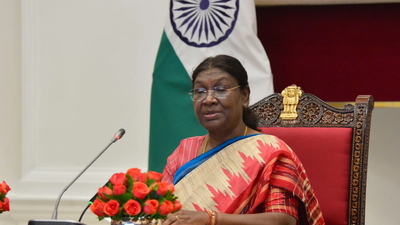


NEW DELHI: Over 140 lawyers, law students, feminists and social activists have written to President Droupadi Murmu urging her not to grant assent to the Transgender Persons (Protection of Rights) Amendment Bill, 2026, and instead send it back to Parliament for reconsideration.The controversial bill was passed in Lok Sabha and Rajya Sabha on Tuesday and Wednesday, respectively, amid demands from the opposition that it be referred to a parliamentary standing committee for wider consultations. The bill now awaits the President’s assent to become law.The signatories of the letter — members of All-India Feminist Alliance (ALIFA) and National Alliance for Justice, Accountability and Rights (NAJAR) — highlight the omission of the provision through amendments to the 2019 law that guaranteed every person the right to “self-perceived gender identity”. They cited this denial as a violation of Constitutional rights.Members of ALIFA and NAJAR — platforms associated with the National Alliance of People’s Movements (NAPM) — in the letter said they are “alarmed” and “distressed” at the undue and unjustifiable haste with which LS and RS passed the “deeply problematic and regressive” bill, “disregarding community concerns, opposition voices and in violation of multiple binding Supreme Court judgments”.The letter said,“In the National Legal Services Authority v. Union of India (2014), SC held that the right to self-determination/self-identification of one’s gender is a fundamental right protected under the Constitution. The bill omits Section 4(2) of the Principal Act, which guaranteed every person the right to self-perceived gender identity, thereby violating constitutional rights of citizens of India.”The letter also objected to the introduction of a medical board, whose recommendation the district magistrate is required to ‘examine’ before issuing a certificate of identity.“While the bill is presented as making implementation ‘more effective’ by reaching those who are “in actual need of protection” the amendments will in fact exclude a vast majority of the most marginalised — economically, culturally and socially — transgender people from accessing protections and rights, they are entitled to under law,” it said.