
It said the recent channel checks indicate a price hike of ₹30 – ₹50 per bag.
The war in West Asia is to trigger three key cost headwinds, which includes a surge in:
- Packaging bag prices
- International pet-coke / coal prices
- Potential increase in diesel prices
The brokerage has factored in the total cost inflation of ₹400 to ₹500 per tonne for the financial year 2027.
The demand in FY27 is likely to be impacted as well. DAM Capital has tempered its volume outlook to 4% for FY27 from the previous year compared to the earlier projection of 7%.
DAM Capital has also cut its EBITDA estimates for the coverage universe by 14% for financial year 2027 and by 12% for financial year 2028.
Valuations are attractive post the recent fall in stock prices, according to the brokerage, who added that even under its bear case scenario analysis, the valuation multiples are lower than the historical average.
External geopolitical tensions and escalating input costs should enforce better pricing discipline, it added.
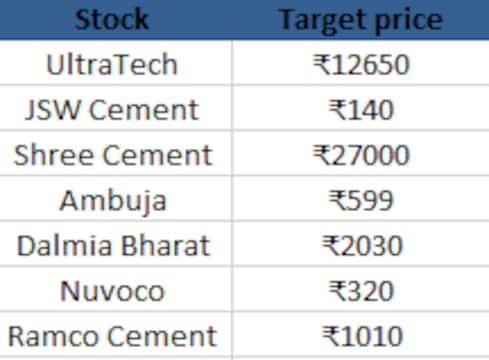
UltraTech Cement and JSW Cement are the brokerage’s top picks, with price targets of ₹12,650 and ₹140, implying upsides of 17.9% and 21.9%, respectively.
Next up, DAM Capital has maintained its ‘buy’ recommendation on Shree Cement and it has a price target of ₹27,000 per share, an upside of 15.7%.

The brokerage has also upgraded its ratings on Ambuja Cements, Dalmia Bharat and Nuvoco to “buy” from their earlier rating of “neutral”.
It has a price target of ₹500 per share on Ambuja Cements, implying an upside of 18.5% and a ₹2,030 apiece target price on Dalmia Bharat, indicating an upside potential of 12.2%.
The brokerage has raised its target price on Ramco Cement to ₹1,010 from ₹320. This implies an upside potential of 7.4% from its previous closing price.
While UltraTech Cement shares ended the previous session 0.2% lower, shares of JSW Cement, Ramco Cements, Shree Cement, Ambuja Cements and Dalmia Bharat ended 1.3% to 5.2% higher.
Also Read: Stocks To Buy: Bernstein bets on this capital markets play but cites a key risk