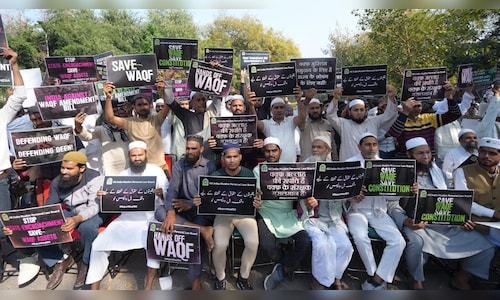

Parliamentary managers of the governing coalition are gearing up for a showdown with the Opposition which vowed to block its passage claiming the move challenges the constitutional assurances to the Muslim minorities. A trailer of the possible scenario was in play when the Houses resumed its sitting on Tuesday after a prolonged three-day break. In the run-up, to raise the stakes against the government’s plan, protests were staged in parts of the country, including wearing an arm black band by members of the community during the special Eid prayers on Monday.
Aware of a possible chink emerging in its otherwise strong coalition, the NDA managers are walking the extra mile to ensure that the numbers are adequate for passage of the Bill when the time for its passage comes up in either House of Parliament. Kiran Rijiju, Minority Affairs Minister, who also dons another hat as the Parliamentary Affairs Minister, stated the government was not just assured of its alliance but securing support for the proposed legislation from the other side of the political divide — the I.N.D.I Alliance.
Focus on TDP and JD (U)
The NDA Parliamentary managers plan to deploy their senior leaders to ensure the coalition numbers show up and vote in its favour. The move comes amid speculation over the possible approach of two of its key constituents – Telugu Desam Party and the Janata Dal (United). While there is no categorical statement from the presidents of both these partners, the two seasoned leaders Chandrababu Naidu and Nitish Kumar are not expected to rock the boat at this juncture. At best, both these parties would attempt to bargain concessions that would protect them from political barbs from the opposition in their respective states.
At present, the JD (U) faces a peculiar situation: it is in coalition both at the Centre and in Bihar, a state headed for assembly elections this autumn. The Nitish Kumar-led coalition government faces a challenge from a coalition led by its principal rival, the Rashtriya Janata Dal which works to consolidate its MY base (Muslims and Yadavs).
In supporting the Bill in an election year, the JD (U) would loathe to build a perception the party joined hands with the BJP to harm the interests of minorities. The party said its Chief Nitish Kumar would peruse the Bill, which has incorporated amendments suggested by the parliamentary panel, before taking a call on it.
On his part, the TDP Chief and Andhra Chief Minister Nara Chandrababu Naidu maintained the party would work to protect the Waqf properties. The Central Government too maintains the Bill would not snatch away Waqf properties but would streamline and digitise holding records. On Tuesday, TDP spokesman Prem Kumar asserted support for the bill, claiming that the Muslim community awaits it.
The Lok Janshakti Party (Ram Vilas) chief Chirag Paswan, recently stated the party has thrown its weight behind the move to have a Joint Parliamentary Committee scrutinise the Bill. His party would now lend voice to the minority group within the Minorities in support of the Bill suggesting that public protests, notwithstanding, there was a section that advocates change. The strategy reflects the government’s approach when it brought about a change in the practice of Triple Talaq amid concerns that it was meddling in the personal laws of the community.
JPC and its work
The Joint Parliamentary Committee set up under seasoned leader Jagadambika Pal, came up with a report which itself was contested by the members of the Opposition who served on it. These members had staged walkouts and disputed the method adopted by the panel. In its report to Parliament towards the end of January, the Chairman said extensive consultation with stakeholders was conducted. Nearly 97 lakh digital and paper submissions were received by the panel, which made over 40 recommendations and 14 amendments moved by governing coalition members on the JPC. These amendments were later incorporated into the Bill, which would be moved on April 2.
One significant suggestion is to rename the Waqf Act, 1995 under Clause 2 as “Unified Waqf Management, Empowerment, Efficiency and Development Act, 1995”. The panel was of the view the updated name reflects “evolving priorities and challenges in Waqf management, emphasising unified administration, inclusivity, operational efficiency and proactive development…addressing systemic gaps while promoting modern transparent and accountable governance in Waqf management”.
Opposition members recorded objections to the Bill through dissent notes and it begins from this clause itself. In his note, Asaduddin Owaisi (AIMIM) stated that while it appears “innocent at first brush, on greater examination reveals itself to be just such a smokescreen, a blatant lie beneath which hides an agenda of systematically weakening the legislative architecture regulating waqfs in India. The proposed Waqf (Amendment) Bill, 2024 is designed to disempower waqfs, take away their management from the hands of Muslims, create hurdles in their efficient administration and hamper the progress of their development”.
Only a reasoned and informed debate on the issue would offer the people an opportunity to cut through the confusion around it and decide which side of the argument carries weight.
—The author, K V Prasad, is an author and political analyst. The views expressed are personal.
Read his previous articles here