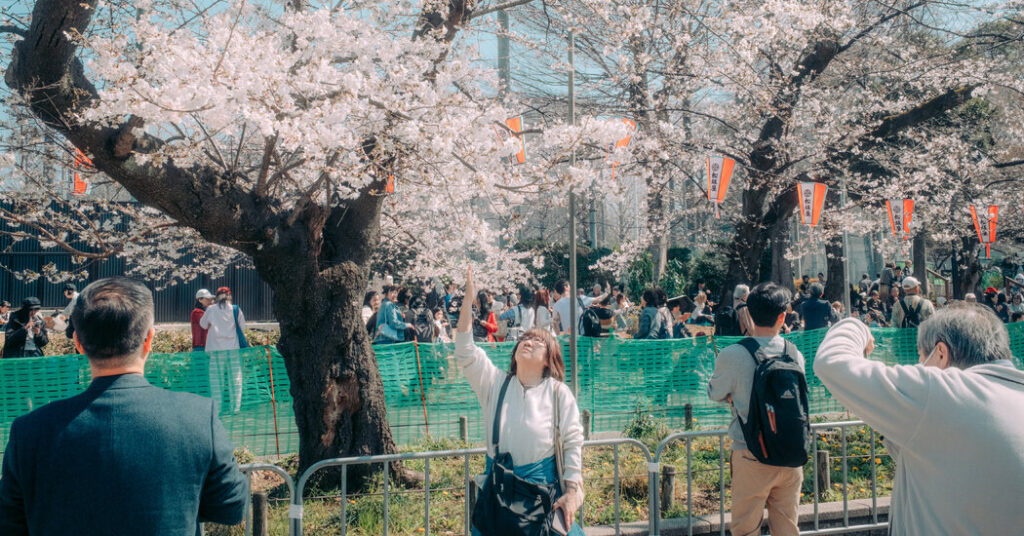

Cherry blossom season is typically a carefree time of year in Japan, when families gather for picnics under blooming trees and friends meet for nighttime “flower viewing.”
For Hiroki Ito, a data scientist and meteorologist who specializes in the high-stakes art of predicting the exact date that the trees will bloom, it has always been a time of stress. Japan’s prized cherry blossoms generate an estimated more than $9 billion in tourism and other revenue each year. Airlines, hotels and restaurants depend on the forecasts — not to mention the 123 million Japanese who want to know when to head to parks and gardens for peak bloom.
“It’s a lot of pressure; I feel the weight of history,” said Mr. Ito, who has worked at the Japan Meteorological Corporation in Osaka, one of the main providers of cherry blossom forecasts, for more than a decade. “I’m a little frightened of spring. I can’t fully enjoy it.”
Now, Mr. Ito and other experts are turning to a tool they hope might reduce some of the burden of forecasting: artificial intelligence. They are using A.I. systems to analyze decades of temperature data, and to deliver maps and “bloom meters” for trees in more than 1,000 spots, which blossom at different times.
This year, forecasters are crowdsourcing photos from the public and feeding them into A.I.-powered databases that can track the growth of buds, which form in the summer, stay dormant through the winter, and take anywhere from two to four weeks to blossom after turning green in the spring.
In the past, experts relied on computer analysis of weather patterns and observations of trees to predict the arrival of the “blossom front,” or the flowering of the trees — with varying success. In 2007, forecasters with the official Japan Meteorological Agency were forced to deliver a televised apology after a computer glitch caused the agency to get the forecast wrong by up to nine days in some places.
A.I. systems have brought more efficiency and precision to the process, scientists say, allowing the first predictions to come out a few weeks earlier, in December — three months before the start of the main cherry blossom season.
Shunsuke Arioka, a forecaster at Weathernews in the city of Chiba, used to rely mostly on basic computer models and formulas for his predictions. Now his company is also running A.I. analysis on thousands of photos submitted by users via the company’s app, which has more than 50 million downloads. On a recent weekend, Weathernews received more than 8,000 images, which were sorted by A.I. into seven stages of bloom.
“It saves a lot of time,” he said. “We are dealing with data from millions of people, and A.I. can help sort them instantly.”
Much is at stake. Millions of foreign and domestic tourists plan trips based on the bloom schedule. Towns and prefectures organize festivals around peak season. Restaurants prepare sakura-themed menus with ingredients like pickled blossoms. Residents plan flower-viewing parties based on the predictions, sometimes lining up at parks overnight to secure coveted spots.
The custom of flower viewing, known as hanami, dates to the ninth century, when Emperor Saga encouraged the public to admire the blooms and commissioned poems about them. In Japan, the fleeting nature of the flowers — they fall off after only a week — is said to symbolize the ephemeral nature of life.
Some of the first blossoms appear in subtropical areas like the island of Shikoku in southern Japan in mid-March; then on the volcanic island of Kyushu; then up the Japanese alps to the northern part of Honshu, the main island; before finishing up in early May in Hokkaido, the northernmost island, near Russia. This year, Tokyo was in full blossom on March 28.
Rising global temperatures in recent decades have pushed the bloom a few days earlier, making forecasts even more difficult. The blooms came early this year because of unseasonably warm weather across Japan.
The Japan Meteorological Agency started predicting the blossoms in 1951. While the agency no longer forecasts blossoming dates, it still plays a role, gathering data and announcing the start of the season to great fanfare.
Even as forecasters adopt cutting-edge systems, they still perform shoe-leather work, inspecting trees up close in green spaces like the Yasukuni Shrine near the Imperial Palace in Tokyo, where officials have studied trees for decades. There, they examine pale pink buds from the main ornamental variety, known as somei yoshino.
At the Japan Meteorological Corporation’s headquarters, Mr. Ito has been poring anxiously over data to ensure the A.I. analysis is on track. The company made 10 predictions since December of the peak bloom date in Tokyo this year and all were accurate to within a day or two.
Mr. Ito said he was hopeful about artificial intelligence — though he said humans would always play a role in predicting blooms.
“I can’t quite relax yet,” he said. “But maybe in a few years, when the A.I. data is proved to be reliable, I’ll be able to feel more at ease.”