
Their confidence was broadly reflected in Thursday’s market rebound, where the Sensex and Nifty both reversed sharp intraday losses. Analysts attributed the recovery to easing crude oil prices, positive global cues, rupee stabilisation and hopes of continued trade dialogue with the US.
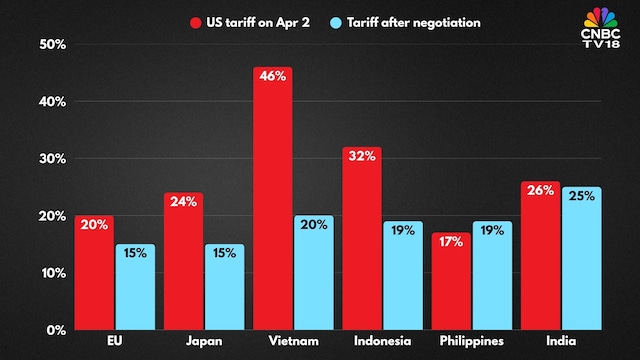
The 25% tariff, announced by US President Donald Trump and effective from August 1, comes with an additional, unspecified penalty linked to India’s trade and defence ties with Russia. While that has rattled exporters and triggered foreign investor selling, the two fund managers believe the broader outlook remains steady.
“India, in that sense, is not that much export oriented,” said Anand Shah, CIO-PMS & AIF at ICICI Prudential AMC . “It’s not been that successful in exporting lots of goods into the US market. And to that extent, the overall impact on the Indian economy and Indian markets would be much smaller.”
India’s total goods trade with the US stood at $129.2 billion in 2024, with exports to India valued at $41.8 billion, while imports from India totalling $87.4 billion. This widened US trade deficit with India to $45.7 billion, up 5.4% from the previous year. The US remains India’s largest export destination, accounting for nearly 18% of outbound shipments.

According to an SBI Research study, a flat 20% tariff could shave up to 50 basis points off India’s GDP, while even a 1% tariff hike could reduce export volumes by 0.5%.
Neelkanth Mishra, Chief Economist at Axis Securities, estimates an additional impact at $6 billion on last year’s export numbers. He said the expectation was that the new tariff rate would be around 15%, which would have raised the total burden of exporters to $12 billion. However, the 25% rate could now push it to $18 billion.
Nilesh Shah called the move a disappointment, especially since India earlier enjoyed lower tariffs compared to others. But he added that the outcome is still manageable. “We have to focus on our domestic economy and continue to engage with the US to get some offset and to get some exemption for items like pharma,” he said.
On sectoral strategy, both fund managers continue to back domestic themes. Anand Shah is leaning into India’s shift from goods to services, with investments in sectors like telecom, healthcare, financial services, and entertainment. “The Indian household is spending more on services. That’s where we’re seeing opportunity,” he said.
Nilesh Shah is watching for signs of government support to accelerate growth and revive private investment. “We need to encourage local industry by improving ease of doing business… that animal spirit is still missing in private investment,” he said.
While mutual funds are sitting on adequate liquidity, he stressed they will stay selective. “We are not here to support the market. We are here to make money,” he said. “When there is so much uncertainty, will we be aggressive buyers? The answer is no.”
Also Read: ‘Time for dispassionate dialogue’: USIBC President on Trump’s tariff push
Still, with long-term demand trends intact, both investors see India’s growth story staying on track—even with new roadblocks from Washington.
Also Read: Trump 25% Tariffs: Pharma stocks that may buck the trend and options that lie before them
For the entire interview, watch the accompanying video
Catch all the latest updates from the stock market here