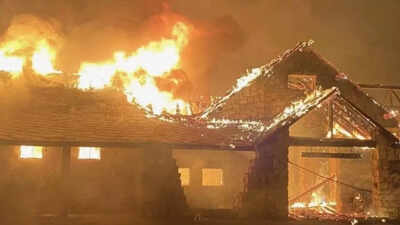


A fast-spreading wildfire has devastated a historic lodge and numerous other buildings on the North Rim of the Grand Canyon. The Grand Canyon Lodge, a historic hotel in the Grand Canyon, was one of dozens of structures destroyed in the fast-moving wildfire in Arizona over the weekend, the National Park Service (NPS) confirmed.The historic Grand Canyon Lodge on the North Rim was consumed by one of two wildfires that were burning about 30 miles apart to the north of the Grand Canyon. According to state and federal fire officials, the fires had grown to over 45,000 acres by July 13.“The Dragon Bravo Fire on the North Rim of Grand Canyon National Park exhibited extreme and volatile fire behavior the evening of July 12, resulting in a 500-acre expansion,” park officials said in a social media post on July 13. “Fire managers have confirmed the loss of the Grand Canyon Lodge and numerous historic cabins in the developed area.”This loss strikes at the heart of America’s natural and architectural heritage: a 1928 landmark designed by Gilbert Stanley Underwood, rebuilt after a 1932 fire, and cherished for its soaring beams, limestone façade, and panoramic “Sun Room.”Here’s an in-depth look at the lodge’s legacy and what lies ahead.
The Grand Canyon Lodge: A century of architectural harmony
The original Grand Canyon Lodge was completed in 1928 by architect Gilbert Stanley Underwood, commissioned by the Utah Parks Company (a Union Pacific subsidiary) and nestled organically into the canyon rim using Kaibab limestone and ponderosa logs. This “park rustic” style blended the building with its dramatic surroundings – a design ethos shared with Zion and Bryce Canyon lodges.
This isn’t the first time the lodge has been consumed by fire.In 1932, a kitchen fire destroyed the lodge, but using much of its original stonework, it was rebuilt by 1937. The revamped structure featured a steeper roof to bear North Rim snow, enhanced stonework, and an expanded Sun Room – adorned with floor‑to‑ceiling windows that offered the first breathtaking view of the canyon for arriving guests. The main lodge served as a dining hall, gathering area, and viewpoint, while guests stayed in 91 standard and 23 deluxe cabins – each echoing the same rustic architectural vision.
The rich legacy: Cultural and historical significance
Recognized as a National Historic Landmark in 1987, the Grand Canyon Lodge was one of the few remaining complete rustic lodge-and-cabin complexes in America’s national parks. Generations of visitors remember the Sun Room’s dramatic canyon panorama, the lodge’s massive hearths, oversized logs, and the comforting retreat from the rim’s harsher elements.
Local enthusiasts and park staff described the lodge’s atmosphere as “pioneer” and “time‑gone‑by,” deepening community ties with its remote tranquility. For many, it was not just an ancient building, but a time capsule – a gateway to the canyon’s spiritual grandeur. Artifacts like the 600‑pound bronze of “Brighty the Burro” added personal lore and cultural value.
Touched by fire
On July 4, the Dragon Bravo Fire was ignited by lightning near the North Rim. Although the blaze was initially managed with a “confine and contain” strategy, it quickly escalated due to high heat, low humidity, and 20–40 mph winds. Within days, it reportedly consumed 5,000–7,800 acres and breached fire lines.Within a week, flames overtook the lodge, visitor center, administrative buildings, waste‑water facility, gas station, and most nearby cabins – destroying roughly 50–80 structures. Officials evacuated all 500+ residents and employees; fortunately, no injuries were reported.
The challenges ahead
The Grand Canyon Lodge – born in 1928, reborn after 1932, and standing for nearly a century – has been lost to wildfire. What’s next after this devastation?At present, officials are assessing the archaeological and historical loss – some archival materials may have survived, but many artifacts are likely gone . As park stewards face the monumental task of restoring infrastructure and assessing ecological recovery, they must balance faithful historic reconstruction with climate resilience and fire safety.How to revive the lodge and retain the legacy?Rebuilding efforts will require structural modernizations – snow-resistant roofing, improved fire breaks – and preserving historic integrity. While Aramark, operators of the lodge, expressed devastation, they join the NPS in potentially seeking funding to rebuild what was lost.