

India has three good reasons to engage with one of the biggest open questions in economics today: the impact of artificial intelligence on jobs.
First, the country has the world’s largest youth population.Second, its growth model has been dominated by software services, and AI tools like Anthropic PBC’s Claude Opus — and the not-yet-publicly-released Mythos — are getting exceedingly good at writing code and finding bugs. But the third and final point may be the most crucial: The threat to entry-level positions comes amid an alarming oversupply of college graduates.
The premium on college education — the wage bump that graduates enjoy over school-leavers — is shrinking, and AI could further narrow the gap.
According to Azim Premji University’s State of Working India 2026 report, the premium peaked in 2011. There has been a surge in the number of colleges — to 450 per million youth in 2021, from fewer than 300 in 2010. But the uneven quality of the new institutions, which are mostly private, didn’t do much to create demand for their graduates. Too many of young, educated males went into agriculture, construction, and retail, the least promising sectors from the perspective of productivity and wages.
History played a role. As China became the world’s factory in the 21st century, India emerged as its remote office. Both pulled their masses out of poverty by creating new income streams for young people leaving villages. But India’s education system, as developed in the 19th century by its British colonial government, was designed to produce clerks and junior administrators.
That pattern continued even after India’s 1947 independence. While China built a foundation of vocational skills and mass literacy that fueled its rise, India doubled down on elite tertiary institutions. The result was the creation of an Octopus Class — a tiny sliver of super-wealthy individuals who serve each other and global markets. That left the rest of the country with more credentials than craft. Only a third of the 5 million graduates coming out of colleges every year are finding salaried positions.
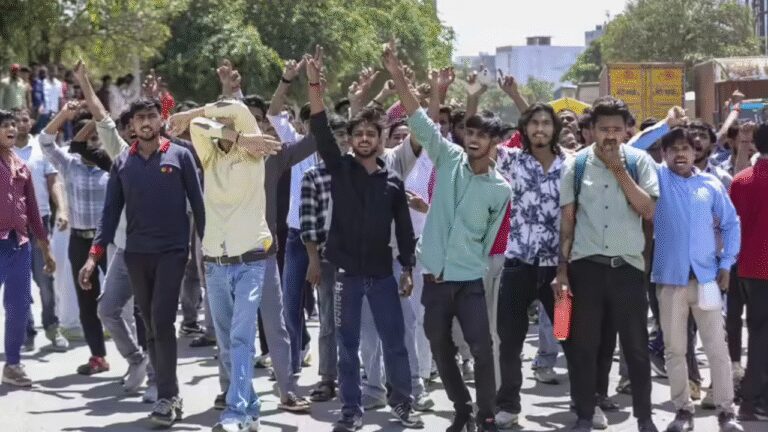
This structural flaw has led to a brutal occupational sorting. In a healthy economy, surplus labor moves from the farm to the factory. In India, because the manufacturing revolution was skipped, graduates find only two doors open: high-end services like IT and finance or the informal abyss of gig work. According to the State of Working India report, graduate unemployment for the 15-25 age group is hovering near 40%. Only a small number of hopefuls secure stable salaried jobs within a year of finishing college.
A generation of young people can envision a middle-class future but lacks the capacity to realize it. Indians now spend four hours a day on mobile devices, much of it devoted to short-form videos. The creator economy is essentially the commercialization of this boredom.
India’s elite, hemmed in by its own risk aversion and stifling bureaucratic controls, has shown little ambition to build the kind of mass-employment manufacturing base that could provide an alternative. At the same time, outsourcing firms have largely prioritized high dividends and stock buybacks over risky moonshots. As global tech giants ramp up capital expenditure to survive the AI revolution, programmers’ skills have become expendable. Thousands of Oracle Corp.’s India employees lost their jobs last month.
The labor market is already reacting. Young men are starting to opt out of higher education to supplement household income. Why spend years on a degree when, according to last year’s World Inequality report, the return on an additional year of schooling in India is lower than in Sub-Saharan Africa?
The good news is that while young men retreat, not only are more women going to college, they’re also using their degrees to close the gender-pay divide. However, while they’re increasingly found in high-growth industries like IT, business services, and automobile manufacturing, their overall participation in the workforce is rather low, compared with other countries at India’s level of development.
The country is nearing the peak of its multi-decade demographic dividend, when a bulge in the working-age population enables faster growth. But without the right jobs, the dividend is turning into discontent. The shrinking college premium is a signal that India’s 19th-century education model has met its 21st-century match.
At the lowest rung of India’s hierarchical, birth-based social order of caste, younger workers are keener than ever to escape their parents’ occupations — like leather and waste management. But they lack the financial resources to use education for upward mobility. The high cost of technical training for poor and lower-caste households must fall drastically. To improve the quality of graduates, the ratio of 3 teachers to 100 students needs to double.
Without a radical pivot toward vocation-oriented training, and a manufacturing industry large enough to absorb those not lucky enough to be part of the elite, the college degree will remain a pricey ticket to a lottery that has stopped paying out. For the millions of graduates trapped in “timepass,” a quirky Indian word for fruitless waiting, lifetime earnings were already looking weak. Now they may just get hollowed out by AI algorithms and agents.
(The views expressed are those of the author and do not necessarily reflect the views of the publication.)